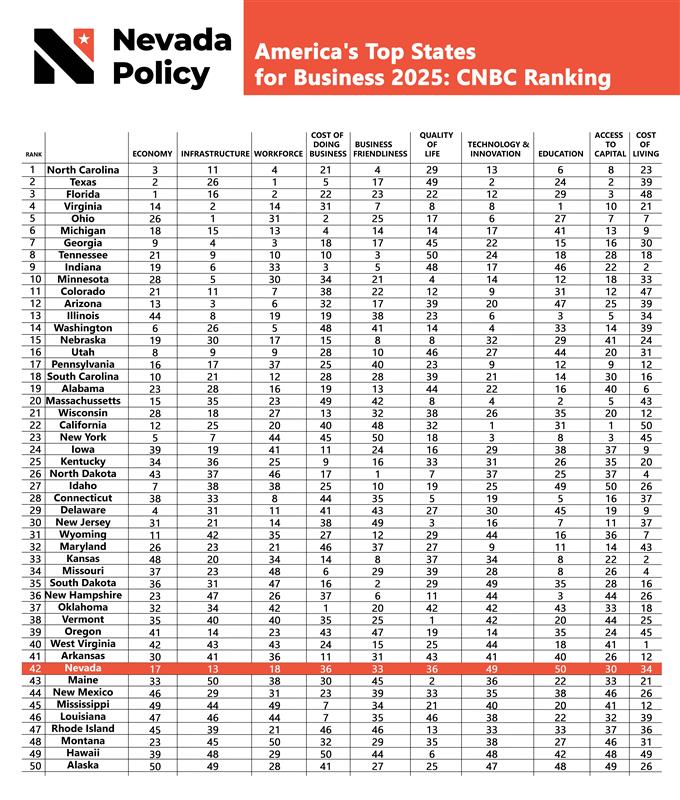
CNBC has released its 2025 “Top States for Business” report — marking 19 years of evaluating state competitiveness using 135 metrics across 10 key categories.
This year, Nevada ranked 42nd overall, down from 39th in 2024. The rankings weigh factors such as economy, infrastructure, workforce, and cost of doing business — all essential components of a healthy business climate. With the nation’s ongoing reshuffling of corporate headquarters and manufacturing bases, Nevada’s slide signals growing challenges in areas the state can no longer afford to overlook.
Below is a breakdown of how the Silver State performed in each of CNBC’s ten categories — and where improvements are most needed.
1. Economy (Score: 246/445)
Nevada’s economic grade dropped notably this year. CNBC measures fiscal stability using credit ratings, reserves, spending, revenues, and pension obligations, alongside GDP growth and job growth over the past year. In most of these areas, Nevada continues to face strain. The state’s unfunded PERS liabilities and limited revenue diversification are red flags for investors seeking long-term stability, as they could signal major tax increases down the road.
The housing market is also an important factor in the score, reflecting a major weakness. Challenges like limited housing inventory, slowing price appreciation, rising mortgage delinquencies, and declining affordability have weighed down overall performance. Strengthening housing stability through balanced development, rezoning, and boosting available supply should remain on top of the legislative agenda of the state.
2. Infrastructure (Score 239/405)
Nevada’s infrastructure ranking highlights the need for a more future-ready foundation to support growth. CNBC’s methodology measures everything from the quality of highways and bridges to the resilience of electrical grids, water systems, and broadband connectivity. With Nevada’s rapid population growth and rising industrial demand, challenges like strained water supply, limited land accessibility, and high energy consumption place increasing pressure on the state’s infrastructure network.
As national standards evolve to include computing power, climate resiliency, and site readiness programs, Nevada must focus on modernizing its utilities and streamlining land-use regulations to attract new investment and sustain long-term competitiveness.
3. Workforce (194/335)
With one of the highest unemployment rates in the nation, Nevada has significantly dropped its rank in the workforce category this year. This ranking underscores the state’s ongoing struggle to attract and retain skilled talent. CNBC’s evaluation considers net migration of educated workers, workforce productivity, and the strength of job training programs—all areas where Nevada faces mounting pressure.
While some legislative efforts such as interstate occupational compacts and ease of occupational licensure were successful in the 83rd legislative session, the Silver State remains one of the most onerously licensed states for occupations. With heavy licensure burdens and limited alignment between education pipelines and industry demand, Nevada risks falling behind in national talent competitiveness. Policies easing occupational participation and removing market barriers are the key to building a resilient workforce.
4. Cost of Doing Business (Score: 114/295)
Nevada remains attractive due to its lack of income tax and favorable regulatory climate, but escalating housing costs, insurance rates, and utility expenses are eroding that advantage. Keeping costs predictable for small and medium-sized enterprises — not just large corporations — will be key to sustaining business growth.
5. Business Friendliness (Score: 126/270)
Nevada ranked 33rd in this category, improving slightly from 36th last year. CNBC evaluates liability climates, regulatory regimes, and support for emerging sectors like AI and cryptocurrency. Despite progress, there are still major reforms that the state should consider to catch up with leaders such as Texas, Florida, and North Carolina. The establishment of a business court is a great foundation that was laid by legislators in 2025. Similarly, policies like lowering registration and licensure fees and eliminating some of the 300 boards and commissions should be considered.
6. Quality of life (Score: 116/265)
Nevada’s 36th place ranking in Quality of Life highlights a challenge in attracting and retaining a diverse and talented workforce. CNBC’s analysis considers factors such as crime rates, environmental quality, health care access, childcare affordability, and worker protections. The state’s ongoing struggles with affordable childcare and housing, coupled with limited access to primary care and behavioral health services, weaken its overall livability appeal. Unfortunately, high costs of childcare are mostly self-inflicted due to an onerous regulatory environment.
As companies increasingly prioritize location decisions based on workforce wellbeing, these shortcomings place Nevada at a competitive disadvantage. Policymakers must view quality of life not as a social metric, but as an economic imperative—a critical factor in shaping the state’s long-term business climate and workforce sustainability. The 2025 legislative reforms to increase availability and accessibility of mental healthcare are a great direction for a start.
7. Technology & Innovation (Score: 77/255)
Despite ranking 49th in the nation for Tech and Innovation, Nevada holds immense untapped potential to reverse that trend. CNBC’s metrics emphasize patents, research funding, semiconductor manufacturing, and AI development—areas where the state still lags. Yet, Nevada’s abundance of available land and relatively low energy costs provide a unique opportunity to attract data centers, AI research hubs, and tech infrastructure investments.
With major firms like Dropbox and TripAdvisor relocating operations to Nevada, the foundation for a tech ecosystem is already being laid. To capitalize on this momentum, legislators should prioritize policies that incentivize tech-sector investment, streamline permitting for innovation-focused developments, and leverage the state’s strategic geography to position Nevada as a low-cost, high-capacity home for the next generation of digital industries.
8. Education (Score: 17/110)
Nevada ranked dead last in the U.S. for education — a metric that includes K–12 test scores, class sizes, and higher education funding. This reflects the widening gap between workforce demand and talent supply. And while there have been notable reforms in the field, the ranking shows that the secondary and higher education systems of the state are still not catching up with the needs of the workforce. This, once again, underscores the massive impact of the Great Nevada Education Crisis, demonstrating that the impacts are far greater than just test scores.
9. Access to Capital (Score: 25/60)
Despite being home to Las Vegas’ booming service sector, Nevada’s capital access ecosystem for entrepreneurs and small businesses remains limited compared to other states.
10. Cost of Living (Score: 26/50)
Housing affordability continues to be a major concern in the cost-of-living category. The report measures median home prices, rent-to-income ratios, and consumer costs — all of which are moving upward. To remain an attractive destination for workers and companies alike, Nevada must expand housing supply and allow market incentives to spur additional investment.
Looking Ahead
Nevada’s overall ranking of 42nd underscores the need for a more balanced economic strategy — one that combines fiscal responsibility, workforce development, and regulatory modernization. As other states aggressively compete for business investment through targeted incentives and innovation-friendly policies, Nevada’s challenge is to move beyond a single-industry or rentier identity and build a foundation to host innovation and entrepreneurship without restraints.
Stay Informed. Stay Free.
Sign up for Nevada Policy’s newsletter to get the latest updates on business freedom, economic policy, and regulatory reform in Nevada. From breaking news to in-depth analysis, you’ll get the information that helps you understand how government decisions impact Nevada’s economy—and what can be done to keep our state open for opportunity.