
The Nevada Legislature is in action—and things are moving fast. Keep this page handy and refresh often for real-time updates on key bills, votes, and debates. We’ll cut through the noise so you know exactly what’s happening and why it matters for Nevada taxpayers. Don’t miss a moment of the special session—stay informed as it unfolds.
Wednesday, 9:00 pm – AB 5 Fails to Pass the Senate
In a dramatic cliffhanger on the sixth day of Nevada’s special legislative session, AB5—the ambitious proposal to pump $120 million annually in transferable tax credits into the state’s film industry over 15 years—narrowly failed to advance in the Senate, falling short by just one vote in a tense 11-12 tally. The defeat caps weeks of intense lobbying from Hollywood giants like Sony and Warner Bros., who touted the bill as a game-changer for creating thousands of jobs and transforming Nevada into a production powerhouse rivaling Georgia and New Mexico.

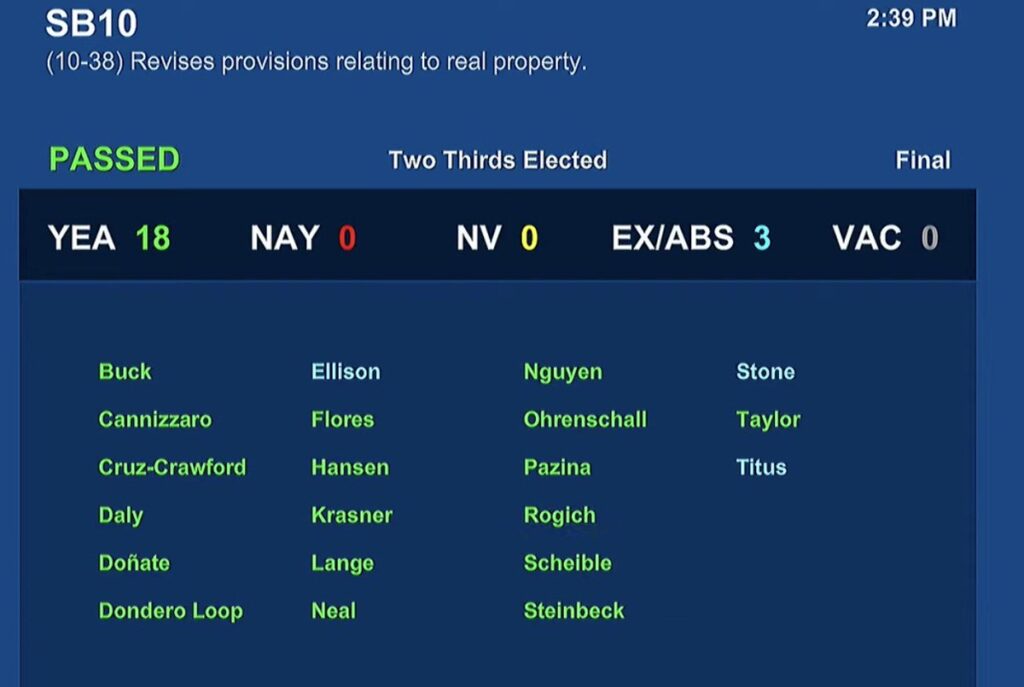
Wednesday, 2:40 pm – SB 10 Passes Easily in Senate
SB 10 easily passed through the Senate, with 18 yeses and 3 absents. It now heads to the Assembly.
Wednesday, 2:00 pm – A Historic Moment for Nevada Legislature
In a historic turn at the Nevada Legislature’s 36th Special Session, lawmakers reconvened this morning—just hours after passing Gov. Lombardo’s crime bill after midnight—to take an unprecedented step: calling themselves into a special session to add a new bill to the agenda.
For the first time in state history, legislators used the constitutional petition process to bypass the governor’s proclamation and introduce their own measure. With bipartisan support reaching the required two-thirds supermajority, Senate Republican Leader Ira Hansen and Assemblymember Alexis Hansen joined the Democratic caucus to add SB 10, a housing bill aimed at limiting corporate ownership of residential property.
SB 10, modeled after bills previously sponsored by Sen. Dina Neal in 2023 and 2025, would cap the number of homes large corporate buyers can purchase each year— 1,000 units statewide according to the most recent publicly available draft. Supporters argue the cap is needed to curb institutional investors who are driving up home prices and squeezing out Nevada families. The opponents explain that the problem with Nevada’s housing market can only be addressed by increasing the supply, not tweaking the demand and intervening with the free market.
A joint hearing of the Senate and Assembly Committees on Jobs and Economy took place where the concerns and bill presentation were presented to officials of both chambers. It unanimously passed out of the Senate committee minutes after the hearing concluded.
This development comes as the 36th Special Session enters its seventh day, with housing affordability and school safety now sharing the spotlight. Other agenda items—including the infamous film tax credit program expansion remain on the agenda.
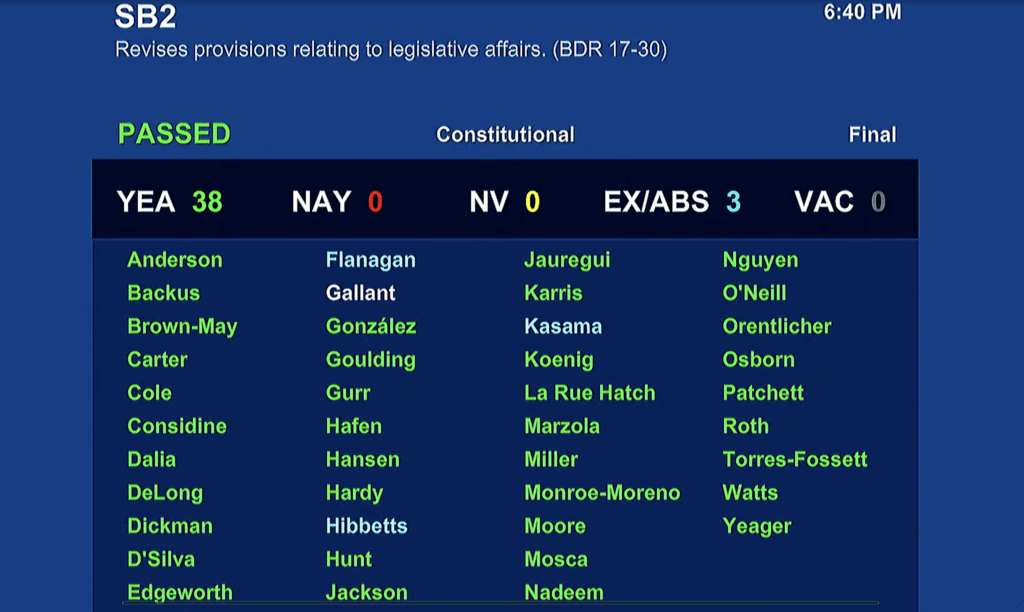
Monday, 7:30 pm – Assembly Unanimously Approves Amended SB 2, Senate Concurs
The Assembly unanimously passed an amended version of SB 2 today, reinforcing an important clarification meant to protect Nevada’s separation-of-powers framework. Lawmakers took up the measure in response to the 2024 Nevada Supreme Court decision in Nevada Policy Research Institute, Inc. v. Miller, which raised concerns that certain executive agencies—including the Nevada System of Higher Education—might fall outside the state’s constitutionally defined branches of government. With the Assembly’s approval, the amended bill returned to the Senate. The Senate concured the amendment.
Sunday, 10:00 pm – AB 5 Passes Through the Senate Committee
After roughly 30 minutes of recess, the Senate Committee on Jobs and Economy has voted to pass the bill. AB 5 will now make its way to the Senate Floor vote.
Committee members who voted “Yes”: Marilyn Dondero Loop, Nicole Cannizzaro, Mark Daly, Dina Neal (reserved the right to change her vote on the floor), Rochelle Nguyen, John Steinbeck
Committee members who voted “No”: Robin Titus, Lori Rogich
Sunday, 8:50 pm – Nevada Policy Presents Opposition with Coalition Urging Senate to Reject AB 5
As AB 5 made its way to the upper house, Nevada Policy President John Tsarpalas joined a broad coalition of community advocates today in presenting opposition to AB 5 before the Senate Committee on Jobs and Economy. In his remarks, Tsarpalas emphasized the bill’s steep cost to taxpayers and the long history of underperforming film tax credit programs. The coalition urged lawmakers to reject the proposal and instead prioritize policies that deliver real, lasting economic value for Nevadans.
The committee now stands in Recess until further notice.
Sunday, 10:30 am – Film Tax Credit Passes Assembly, Moves to Senate
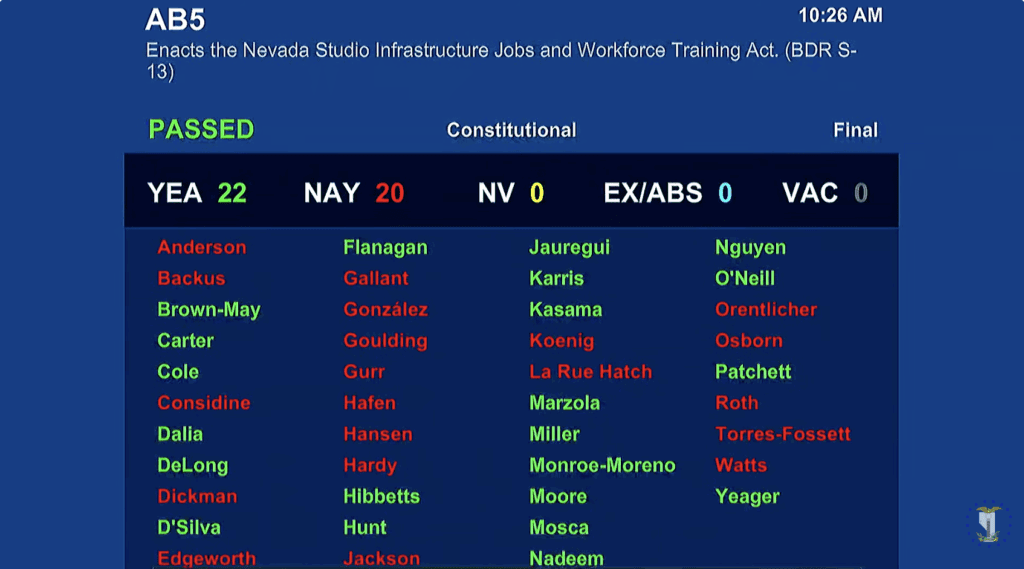
AB 5, the proposal to dramatically expand Nevada’s film tax credit program, passed the Assembly this afternoon on a 22–20 vote. With Assembly approval secured, the bill now heads to the Senate for consideration.
Email Your Senators NOW
Sunday, 10 am – Film Tax Credit Voting Has Started
Floor remarks from the legislators can be watched here.
Sunday, 9:50am – How many more emergencies can we make?
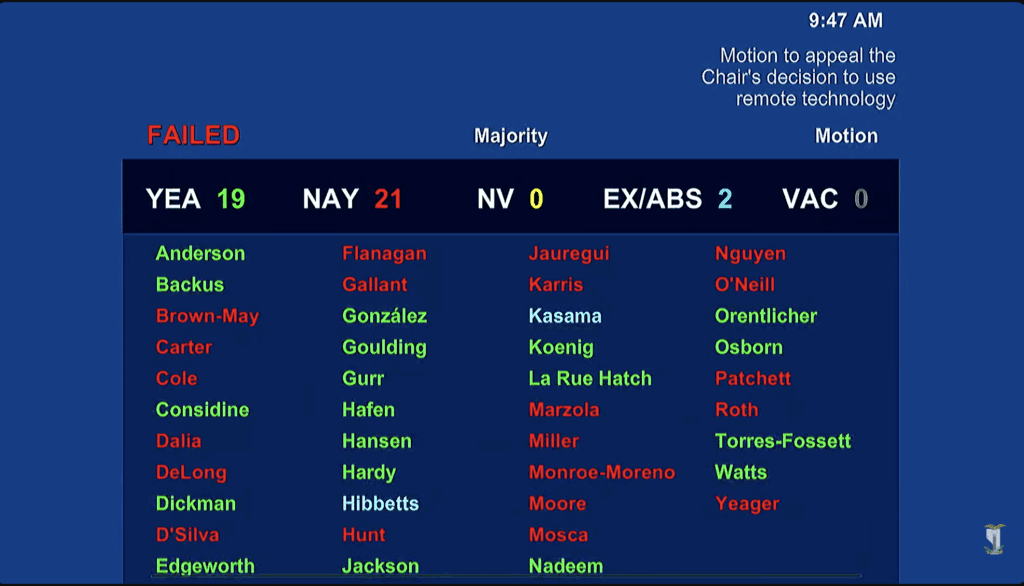
The Assembly gaveled in on Sunday morning with an unexpected procedural dispute. Speaker Yeager announced that, under Rule 126(2)(A), he had determined with the legal counsel that Assemblymembers Hibbetts and Kasama would be permitted to participate and vote remotely due to “exceptional circumstances.”
Assemblymember Torres-Fossett immediately appealed the decision, arguing that personal travel does not constitute an emergency and warning that allowing remote votes under such circumstances could set a troubling precedent.
With 40 members physically present, the appeal needed 21 votes to overturn the Speaker’s ruling. The motion fell short — receiving 19 yeas and 21 nays — meaning the Speaker’s decision stands, and both legislators will be allowed to vote remotely.
The majority party might have lost the sight of what is an emergency for Nevadans…
Saturday, 4:00pm – Assembly Adopts AB5 Amendments on the Floor — Adjourns Until Sunday, Delaying a Final Vote
Twice today, Assembly Majority Democrats attempted to declare AB5 an “emergency measure” — a move that would sidestep the standard procedural requirements outlined in Article 4, Section 18 of the Nevada Constitution. The effort failed, which means the bill will not be voted on tonight. Instead, the vote is now pushed to tomorrow. The timing has raised eyebrows amid growing speculation that some legislators may need to leave Carson City.

With 26 Yeas and 16 Nays, the motion failed to receive a two-thirds vote, delaying the floor vote until tomorrow. Immediately after the vote, the chamber stands adjourned until Sunday, November 16th at 9:00 a.m.
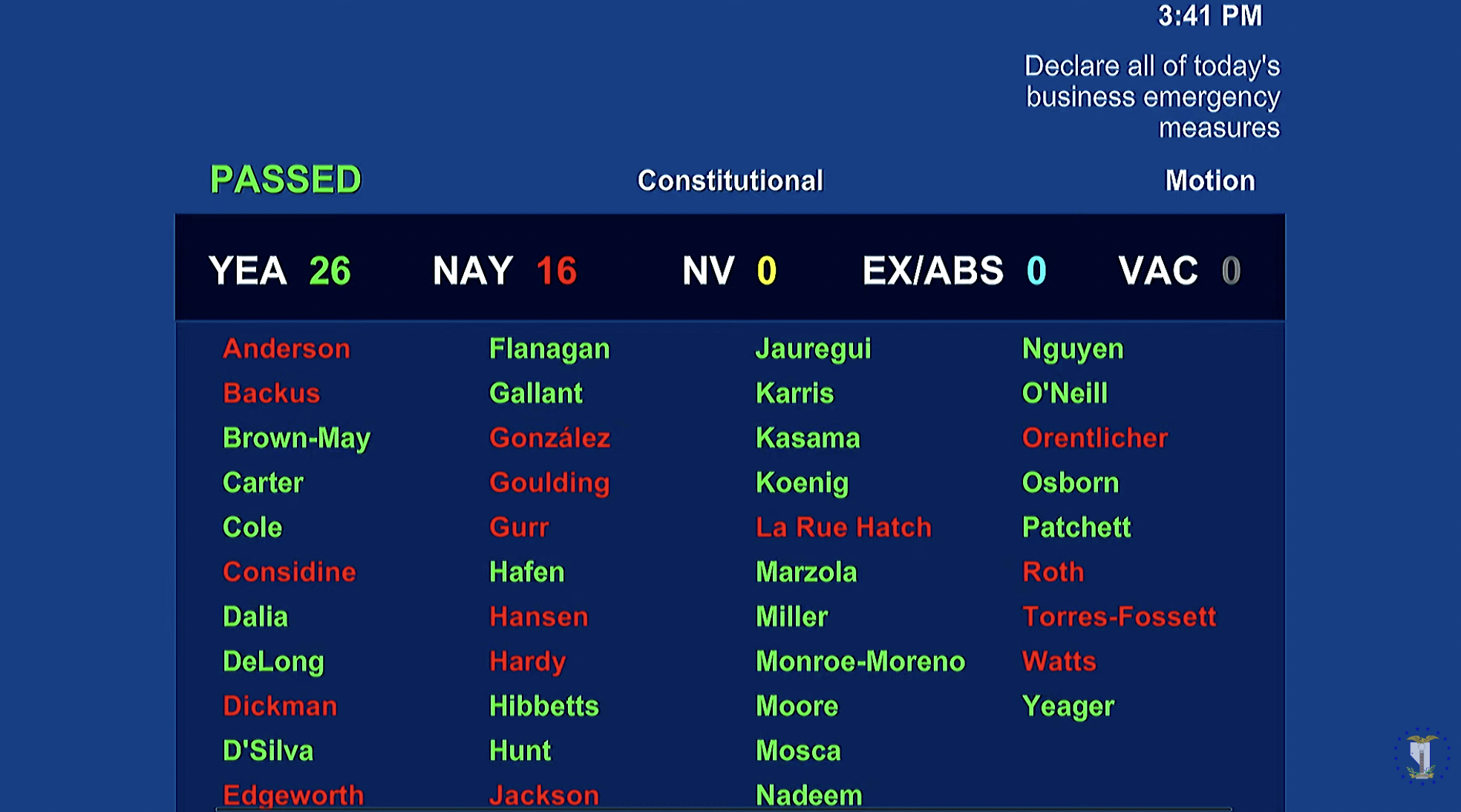
Additionally, the Assembly has now formally adopted all the amendments to the bill. These amendments were never discussed during the 83rd regular session nor in the five-hour-long committee hearing earlier this week. This strongly suggests extensive behind-the-scenes negotiations taking place outside the public eye, with major policy implications for Nevada taxpayers.
Below is a breakdown of the key changes as the file finally has become available to the public — and why each introduces additional risks:
1. Major Tax and Revenue Shifts
The amendment pledges the basic city-county relief tax to the production studio district, narrowing the revenue available to local governments while guaranteeing revenue backstops for a single industry. It also allocates 4% of lodging tax revenues to retiree medical benefits under PEBP beginning in 2031–32. This politically calculated move creates a complex fiscal interplay that further entangles the film incentive program with long-term state obligations, raising the cost of future policy reversals.
2. Project Restrictions in Summerlin
Summerlin Production Studios Project site will be prohibited to host any gaming establishments, ensuring that the gaming industry faces no competition with this major political investment.
3. Funding Reallocations Through Third-Party Partnerships
The amendment also revises Section 10, subsection 1(e), subparagraphs (6) and (7), removing references to the Eastside Education and Training Center that was previously given priority and redirecting $6,000,000 toward constructing a center in conjunction with Chicanos Por La Causa on Las Vegas’s east side, as determined by the lead participant and GOED. Additionally, the 1% contribution to the Nevada Film, Media, and Related Technology Education Account will now be transformed into a credit reduction by GOED, with equivalent funds credited to the account. The structure further complicates “Hollywood” accounting for the state.
4. Diversity Requirements With Penalty Triggers
This amendment adds “race” to Nevada’s definition of workforce diversity and pushes companies receiving these film-related incentives to show they are actively hiring a workforce that reflects Nevada’s population. If a company doesn’t meet the diversity goals in its plan, it loses 5% of its tax credit. The amendment also removes old training-program lists and instead focuses on boosting participation of underrepresented groups in production, directing, and technical jobs.
5. Increased Reporting With Broad Confidentiality Carve-Outs
New Section 19.1 mandates biennial reports from lead participants on production expenditures, employment demographics, high-compensation personnel (> $1,000,000), and percentages of Nevada residents in above- and below-the-line roles (by workdays, wages, and occupation). GOED may modify reports to protect sensitive data but must preserve employment and spending details, allowing aggregation to avoid disclosures. Cross-references eliminate duplicates, and reports include copies from Section 20.
Together, these amendments paint a picture of a bill still evolving without public knowledge or participation while increasing in scope, cost, and complexity. We will continue tracking developments as AB5 heads toward its critical floor vote.
Friday, 6:45pm – AB 5 Clears The Committee and is off to the Assembly Floor
Assembly Bill 5 — the film tax credit expansion proposal — just went through the work session as lawmakers reviewed the latest amendment to the bill. The newest version includes several notable changes, most significantly a reduction in the DEI-related hiring requirements that had been a central point of contention during earlier hearings and alignment of dates. Members also raised final questions about the economic assumptions behind the program, including how transferable credits would impact the state’s long-term fiscal health, as well as the details surrounding studio investment planned for Downtown Summerlin. Importantly, the seven-page amendment is an 11th hour effort.
Committee members who voted YES: Daniel Monroe-Moreno, Sandra Jauregui, Steve Yeager, P.K. O’Neil, Heidi Kasama, Brian Hibbetts, Max Carter, Erica Mosca, Greg Koenig (reserved the right to change his vote on the floor).
Committee members who voted NO: Natha Anderson, Gregory Hafen, Shea Backus, Howard Watts, Selena Torress-Fossett.
Friday, 10:30 am – Floor Sessions and Key Committee Hearings Expected to Begin Shortly
Activity is about to pick back up in Carson City as the Senate floor and all three Assembly committees prepare to convene at any moment. Lawmakers are moving quickly through the special-session agenda, but two of the highest-profile bills remain pending in Assembly committees — and both are expected to draw significant public attention once they are brought forward.
The film tax credit expansion bill (AB 5) and Governor Lombardo’s crime bill have yet to receive votes in their respective Assembly committees. These are the marquee proposals of the special session, the votes for these can be determining for the “success” of the 36th Special Session.
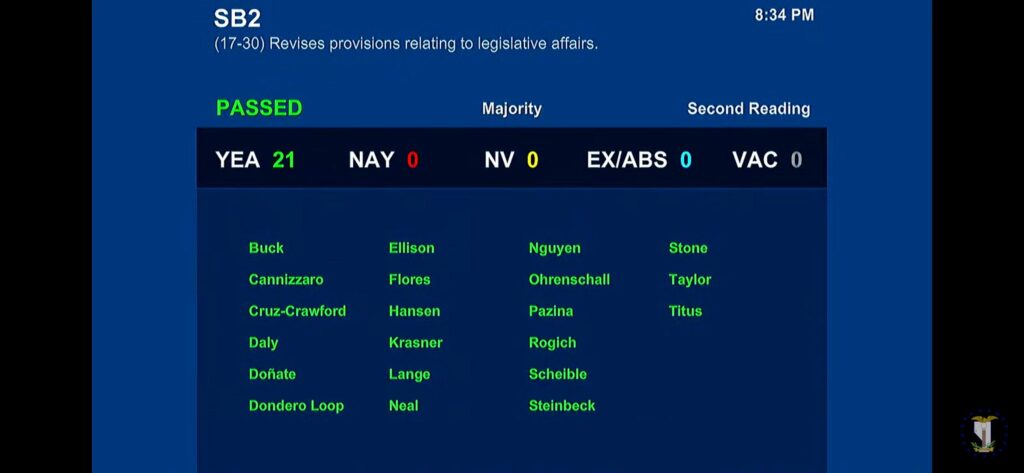
Thursday, 8:40 pm – SB 2 Unanimously Passes Senate
Senate Bill 2 passed through the Senate floor unanimously, providing an important clarification to preserve Nevada’s separation-of-powers framework. The need for this measure stems from a 2024 Nevada Supreme Court decision, Nevada Policy Research Institute, Inc. v. Miller, which suggested that some executive agencies—including the Nevada System of Higher Education (NSHE)—might exist outside the state’s constitutionally defined branches. The bill is now off to the Assembly.
Thursday, 7:40 pm – Nevada Policy Testifies in Opposition of the Film Tax Credits
Nevada Policy testified before the legislative committee in opposition to the proposed film tax credit bill. While advocates argued the incentive would boost production jobs and bring new revenue, Nevada Policy raised concerns over cost-effectiveness and long-term fiscal impact on Nevada’s budget, bringing forward evidence of these programs’ failure in other states.
During testimony, opponents highlighted several key issues: the state’s history of underperforming film tax credits, the risk of diverting tens of millions of dollars away from core services, the tendency for large studios to claim credits without creating lasting economic benefits for workers in other states, the ginormous giveaway to billion-dollar companies, and more. They also stressed that the bill’s sharply increased cap could shift financial risk onto Nevada taxpayers with little accountability.
The committee did not vote on the measure and is expected to reconvene tomorrow at 11 a.m. for further discussion and a work session.
Thursday, 3:20 pm – Committee Hearing on Film Tax Credits Has Begun
The hearing of the film tax credit measure, Assembly Bill 5, began in the Assembly Committee on Jobs and Economy.
Bill sponsor Assemblymember Sandra Jauregui laid out the proposed structure. She was followed by testimony from John Vellardita, Executive Director of the Clark County Education Association (CCEA), and Jhone Ebert, Superintendent of CCSD. Together, they described how the legislation is expected to generate about $11 million annually for CCSD via an entertainment‑district revenue stream. The funds are to be collected from the state’s entertainment‑industry zone and invested only in Pre-K education of CCSD.
The hearing is ongoing, and public testimony will be accepted in the coming hours. Notably, the Committee Chairwoman has allowed 1 hour testimony time for each stance of the public – support, opposition, and neutral.
Former Governor and current president of UNR, Brian Sandoval, and the Interim President of UNLV, Chris Heavey, were also among the presenters positioning the measure as a win-win for the NSHE system. They argued that Summerlin studios will prompt the creation of a strong education-to-workforce pipeline, attracting both professors and students to the Silver State institutions.
Stakeholders from the film industry, business community, education sector, and taxpayer‑advocacy groups are expected to speak.
Thursday, 2:05 pm – Nevada Policy Testifies in Support of Separation of Powers Bill
In the Senate Committee on Public Safety and Security Senate Bill 2 (formerly Assembly Bill 600) received its first hearing. The bill provides a critical clarification to ensure that Nevada’s separation-of-powers framework — dividing government into legislative, executive, and judicial branches — is preserved.
The need for this clarification arose from a 2024 Nevada Supreme Court decision in Nevada Policy Research Institute, Inc. v. Miller. In that case, the Court interpreted the Legislative Counsel’s administrative decisions in organizing the Nevada Revised Statutes by subject matter as an indication that some executive agencies, including the Nevada System of Higher Education (NSHE), might exist outside the three constitutionally defined branches. This interpretation effectively treated NSHE as a “fourth branch” of government, contrary to the state constitution and longstanding judicial precedent.
Nevada Policy emphasized that this clarification is not only legally important but essential for maintaining the integrity of Nevada’s constitutional structure. By supporting Senate Bill 2, the Legislature can prevent misunderstandings that could disrupt the balance of power among the state’s coequal branches and ensure that all agencies, including NSHE, operate under proper constitutional authority. The bill will move to the Assembly Floor for votes and to the respective Senate Committee later.
Thursday, 12:10 pm – The Objection of Film Tax Credits to Progress to the Committee Fails
Following Assemblymember La Rue Hatch’s objection to progress Assembly Bill 5, the film tax credit expansion proposal, to the Committee on Jobs and Economy by enaction of the Assembly Standing Rule 109. The assembly voted on the matter: a YES vote would have prevented the bill from being referred to the committee, effectively killing it, while a NO vote would allow the bill to progress further in the legislative process.
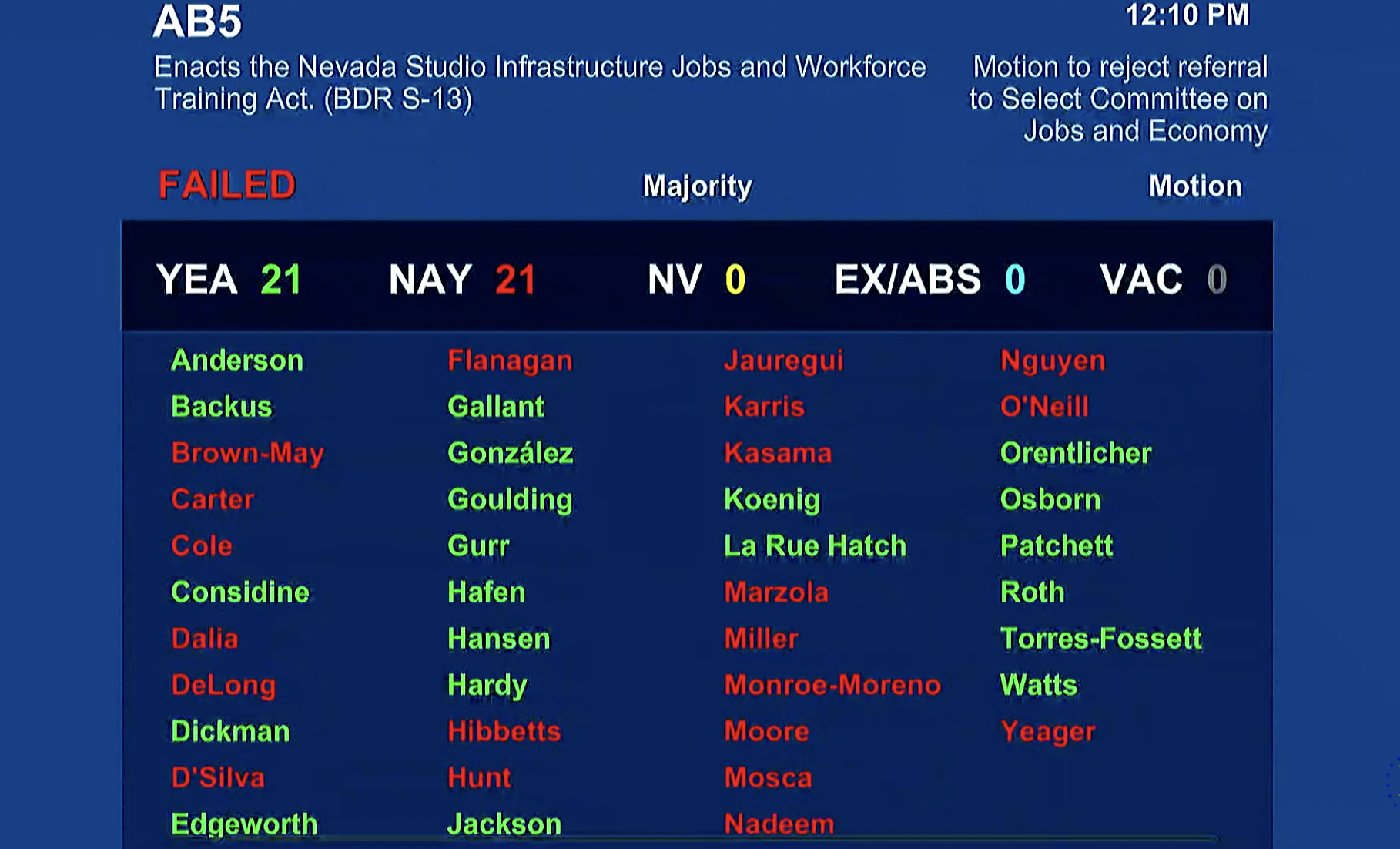
With 21 Yes and 21 No votes, the bill has now progressed to the Assembly Committee on Jobs and Economy and will be heard later today. The tight vote indicates a strong disagreement in the legislative body about the fiscal health of the transferable tax credits for the film industry, hinting heated upcoming debate.
You can reach out to your legislator, urging them to vote on this bill using Nevada Policy’s Action Center.
Thursday, 11:30 am – Floor Sessions in Both Chambers Underway
The floor sessions in both the Nevada Assembly and Nevada Senate are now underway. In the Assembly, a leadership change has taken place: Danielle Monroe‑Moreno has stepped down from the role of Speaker Pro Tempore, and Elaine Marzola was voted in as her successor. Meanwhile, the two vacant Assembly seats have been filled: Jason Patchett has been appointed to represent District 19, and Blayne Osborn for District 39.
The committees of both chambers, as announced, include Health and Wellness, Jobs and Economy, and Public Safety and Security. Additionally, the 36th Special Session will not take telephonic testimony during the committee hearings.

On the floor, bills are being referred to Assembly committees. Notably, Selena La Rue Hatch signalled objection by referring to ASR 109—a motion objecting to the referral process. The Assembly has gone into recess as lawmakers navigate how to address that motion.
Under Assembly rules, the first reading of a bill is informational: if there is an objection, the question asked is, “Shall the bill be rejected?” If a majority of members present vote “yes,” the bill is rejected and may not be reconsidered. If no majority objects—or there is no objection—the bill moves forward. If Assemblymember La Rue Hatch’s objection under ASR 109 succeeds, the bill in question would be formally rejected on first reading, meaning it cannot be reconsidered, reintroduced, or referred to any committee for the remainder of the special session.
Wednesday, 7:00 pm – Gov. Lombardo Announces a Special Session
Following his vague media release of intent to call a special session last month, Governor Lombardo has officially called a special session to convene on Thursday, November 13th.
Just five months after the conclusion of the 83rd legislative session, elected officials will return to Carson City to discuss what Gov. Lombardo called unfinished business. The list includes some high-profile bills that did not make it out of the chambers before Sine Die, such as film tax credit program expansion and Governor’s crime bill.
In his proclamation, Lombardo also included that the legislators will be considering measures pertaining to cybersecurity, school zoning, public officer privacy, and labor standards.
As outlined in the proclamation, the following bills are also included in the agenda:
- Senate Bill 194 (1st Reprint): Concerning insurance requirements for short-term vehicle leases.
- Senate Bill 434 (3rd Reprint): Establishing the Statewide Health Care Access and Recruitment Grant Program to address provider shortages across Nevada.
- Assembly Bill 404 (2nd Reprint): Revising laws governing the sale and regulation of alcoholic beverages.
- Senate Bill 450 (1st Reprint), 82nd Session: Continuing relocation efforts for residents of Windsor Park in North Las Vegas.
- Assembly Bill 600 (as introduced): Clarifying provisions related to legislative property, publication procedures, and statutory organization.
While each bill has urgency for smaller audiences, the proposal that has generated the most buzz is Hollywood giants Sony and Warner Brothers’ expansion attempts to the Silver State. Supporters argue that the bill will create jobs, diversify Nevada’s economy, and put the state on the map for major Hollywood productions. Critics, like Nevada Policy, however, show that such subsidies fail to deliver on their promises. Many states have long determined the fiscal nature of these policies to harmful to state economies.
In fact, nearly every state with a film incentive program has faced controversy over transparency, cost overruns, and whether the economic impact justifies the loss in tax revenue. Nevada’s proposal would dramatically expand the existing credit program to $120 million in transferrable tax credits and commit the state to hundreds of millions in foregone tax dollars. This sparks concern from businesses, advocates, and residents of the state about whether the benefits will stay in Nevada once the cameras stop rolling. And the answer, much likely, is no.
With lawmakers expected to begin hearings tomorrow, Nevadans can anticipate intense negotiations and rapid developments as the session unfolds. Taxpayer money, safety, and economic future are at stake in Carson City for the rest of the week.