
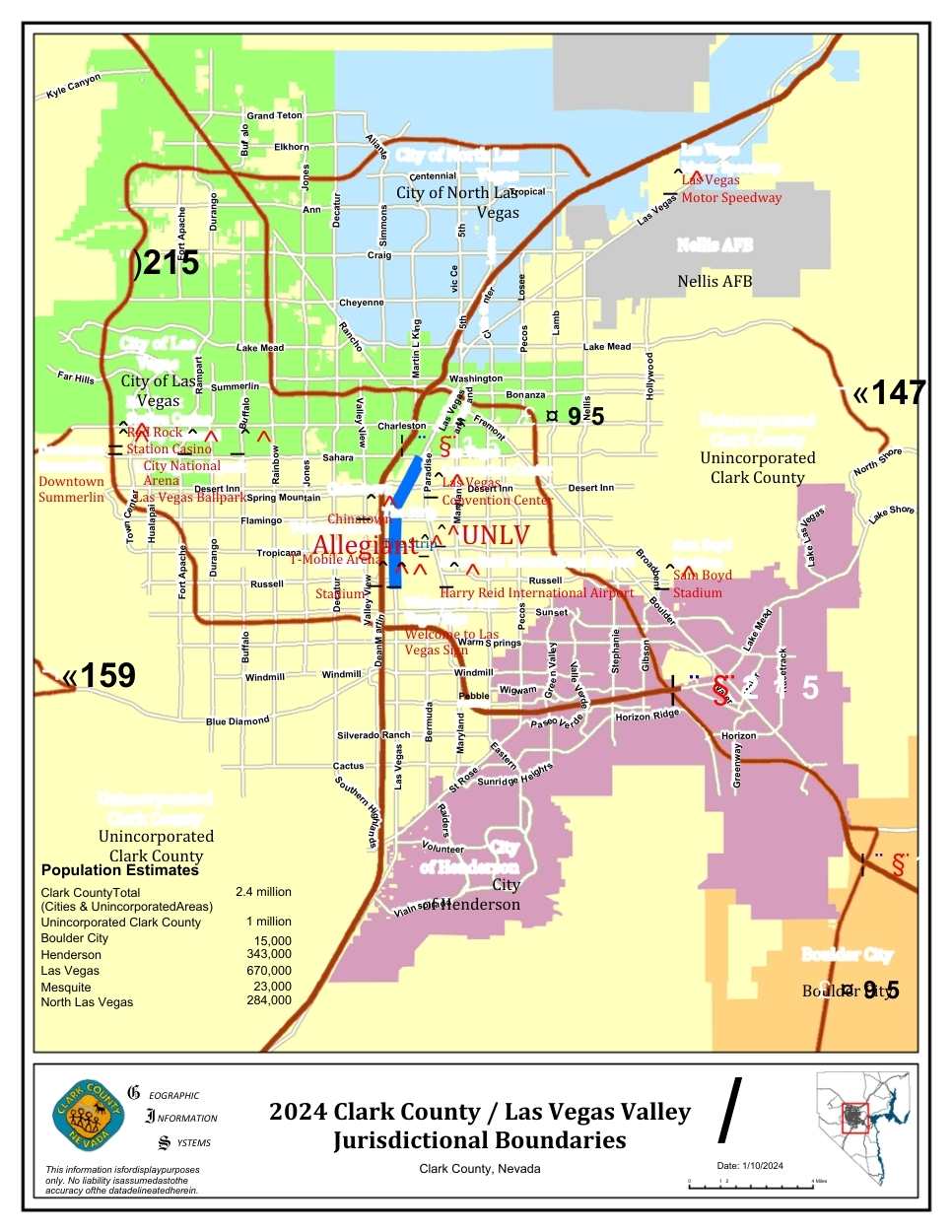
In 1998, Clark County made it illegal to operate a short-term rental for less than 31 days in its unincorporated areas, including the Las Vegas Strip. The violation of the ban could result in fines of $1000 per day. Yet, despite the decades-long persistence of this ban, many short-term rentals (STRs) were operating on websites like Airbnb and Vrbo.
Clark County Forced to Legalize Short-Term Rentals—On Paper
In 2021, the Nevada Legislature passed AB 363 to reverse the STR ban. With the passage of this law, Clark County Commission was obligated to publish an ordinance and establish a licensure pathway for homeowners on or before July 1st, 2022. The final version of the adopted ordinance placed ominous requirements on both the property owners and residential units, such as:
- No STR units within 2,500 ft from a resort hotel or within 1,000 ft of another unit,
- No more than one license for a single person/business entity in unincorporated areas,
- Allow the County to inspect the residential units without advance notice,
- Grant the County the right to issue a misdemeanor citation for any violations, effectively risking criminal liability for misplacing trash or parking on the street, even if these infractions were the result of tenants’ actions.
Distance Requirements, Inspections, and Criminal Penalties
These provisions, while clearly designed to protect Southern Nevada’s large resorts from competition for housing visitors, would also result in completely arbitrary outcomes. If a homeowner three blocks away from you simply has their application for licensure processed before your application, you would be barred from being able to lease your home because of the distance requirement. In fact, the entire ordinance treats housing leases like a privileged license, although people are just agreeing to let someone else use their private property to which the government holds no claim.
With this ordinance in place, the county launched its pre-application process from September 2022 to August 2023. More than 1,000 eligible pre-applicants were allowed to progress to the actual application cycle (because, of course, every government application needs a pre-application). The County then implemented a lottery ranking system instead of a first-come, first-served approach leaving the existing applicants in a limbo as well. Many homeowners were caught in a trap engineered by the County Commission. They could either operate STRs without a license and risk a violation or lose the right to use their property home to generate an income while awaiting some future act of government.
Airbnb and Homeowners Challenge Clark County in Court
The Greater Las Vegas Short-Term Rental Association (GLVSTRA), alongside individual homeowners and Airbnb, brought the case to the Nevada Supreme Court questioning the constitutionality of county regulations. The plaintiffs requested emergency preliminary injunctive relief, arguing that the enforcement of the ordinance does and will continue to cause irreparable harm to Nevada homeowners. In August 2025, Judge Miranda Du granted an emergency preliminary injunction that blocked the enforcement of new additions to the ordinance. The latter would require Airbnb to remove unlicensed listings across its website. The company could face fines for bookings without licenses, even though the platform itself has no responsibility to police individual homeowners—it is only a middleman that offers booking services. This emergency injunction bought time for Airbnb and the homeowners; however, it did not address the constitutionality concerns at the core of the case.
In December 2025, Judge Du found sufficient likelihood that Clark County’s enforcement regime consisting of license requirements, fines, and distance requirements violated the 14th Amendment rights of Nevadan property owners. As a result, a second preliminary injunction was granted, meaning the county cannot impose many of the most restrictive provisions while the case proceeds. The final resolution of the case is still pending.
Proof the Licensing System Is Broken
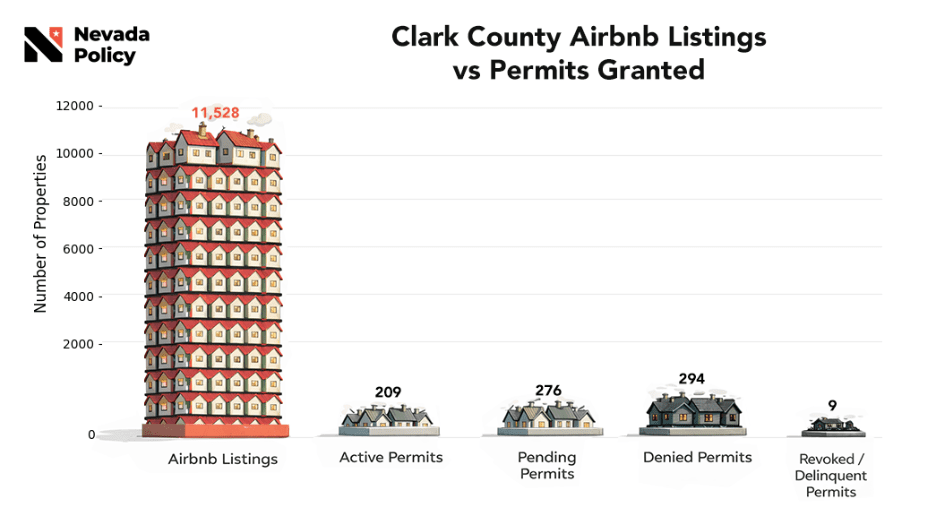
As of February 2026, the county official records show that of over 11,000 short-term rental listings, only 209 permits have been approved. Nearly 300 applications have been denied, while 276 remain pending. This artificial licensing barrier has allowed only 1.8% of all eligible properties to operate lawfully in the market.
Although the immediate externalities of this regulatory failure may be resolved in the courtroom, its implications are far bigger than a single case. Clark County provides a textbook example of what happens when free markets are artificially constrained by governmental overreach. Economic activity is undermined, essential rights of individuals are violated, and special-interest lobbies are favored. By establishing a dysfunctional licensing system and trapping property owners in it, Clark County created an enforcement mechanism that is nothing short of a punishment. If Nevada hopes to have a business-friendly reputation, Airbnb’s fight with Clark County should serve as a cautionary tale – government cannot regulate innovation out of existence, especially not from the living rooms of its residents.
Stay Updated on Nevada’s Biggest Policy Battles
Get clear, timely updates on the laws and regulations shaping Nevada’s economy, housing, education, and government. Sign up for our newsletter to stay informed with new research, breaking developments, and opportunities to take action.