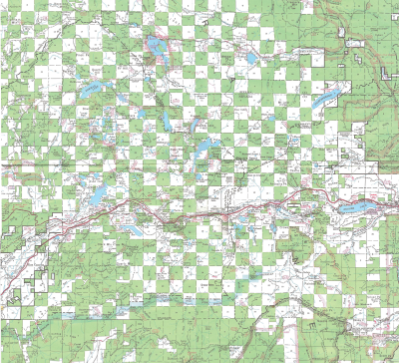
Picture a checkerboard: a grid of alternating dark and light squares. This pattern shapes the daily lives of many residents of the American West. In states like Nevada, Wyoming, Oregon, and more, public and private lands are interlocked in an actual checkerboard pattern, causing conflicts over how public lands are accessed and how private lands are managed.
A Railroad Deal From 1862 Still Shapes Nevada
The checkerboard pattern dates back to the development of the transcontinental railroad. In 1862, Abraham Lincoln signed the Pacific Railway Act, which authorized federal land grants to railroad companies as an incentive to build rail lines across the west. The grants followed an alternating pattern of sections along the railroad, with the federal government retaining every other square mile. The idea was that the railroad companies would develop their parcels and encourage settlement.
Over time, however, much of the railroad land was sold off to private individuals. The result was a landscape in which private and federal sections became interlocked. More than 150 years later, the pattern remains largely the same, with the federal government keeping sections for no foreseeable reason.
Today, west of the Mississippi river, the Bureau of Land Management (BLM) oversees 245 million acres of land. About 8.3 million of those lands are part of the checkerboard pattern. Nevada alone accounts for 2 million of those acres. This matters immensely, given 85% of Nevada is federally owned, and 62% of private land in the state sits in a landlocked sea of BLM land affecting ranchers, residents, and businesses alike.
Private Property Meets Public Access
Checkerboard ownership creates hurdles for everyone involved, with a basic property rights problem at its core. Private property includes a fundamental right to exclude others from that property. The U.S. Supreme Court has upheld that principle repeatedly. At the same time, the public has an interest in accessing land that belongs to the federal government.
Normally, these principles are straightforward. A private landowner controls access to private property, while the public can utilize federal lands. Checkerboarded land pits these interests at direct odds with each other.
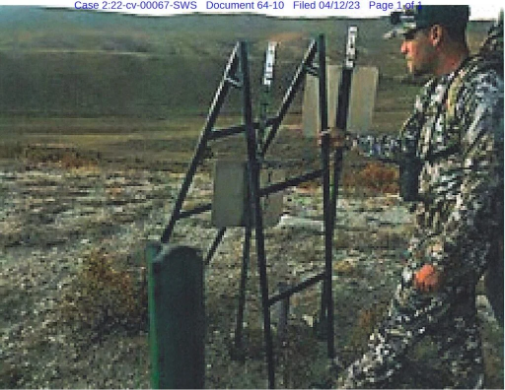
Think of a hunter trying to reach a federal parcel surrounded by private land. The hunter needs permission from neighboring landowners or must find an established public easement. Another possibility is “corner crossing” – moving from one public parcel to another at precisely the point where four parcels meet without stepping onto the private land. That practice has become the subject of recent litigation.
Source: U.S. District Court. “Judge Rules in Favor of Corner-Crossing Hunters,” by Angus M. Thuermer Jr., Wyoming Tribune Eagle, 28 May 2023, www.wyomingnews.com/news/local_news/judge-rules-in-favor-of-corner-crossing-hunters/article_07ec805c-fcc0-11ed-adca-6362e0102876.html.
The Hunters Who Brought a Ladder
Four hunters from Missouri, facing this problem, used a ladder to step from one BLM parcel to another in Wyoming, crossing the corner without ever physically touching the neighboring rancher’s property. The rancher who owned the private lands at the intersection, argued that the hunters trespassed by passing through the airspace above his property.
The issue resulted in a Tenth Circuit case. The court disagreed with the rancher, ruling in the hunters’ favor, effectively legalizing corner crossing if you are not physically touching private lands.
However, the ruling holds only in Tenth Circuit states: Wyoming, Utah, Colorado, New Mexico, Kansas, and Oklahoma. Nevada falls outside that purview, so corner crossing remains a gray legal area. GPS coordinates and boundary markers have to be exact, and even mapping tools like OnX don’t always place corners correctly.
Ranchers Pay the Price Every Square Mile
For ranchers, much like those caught up in the federal appellate court, the checkerboard presents a series of complications beyond trespassing. Not only do the lines of private property get blurred, but managing livestock across a landscape where every other square mile belongs to the BLM means constant coordination with federal grazing permits and range management rules just to move cattle or maintain fences. Selling or developing a parcel gets harder when its value and use are tied up with a federal neighbor whose management priorities shift with each new administration.
Even the Federal Government Can’t Manage Its Own Squares.
Lastly, the checkerboard is as much of a headache for the government as it is for neighboring private landowners. For BLM officials, isolated parcels can be difficult to reach for wildfire prevention and containment, invasive-species control and vegetation management. In other words, checkerboarding does not just restrict public access – it also makes the federal land itself harder to manage efficiently, even for the government.
One example of failed management is the so-called hoax highways. The federal government enacted R.S. 2477 roads in 1866 to allow roads to be established across federal land. Congress repealed the law in 1976, but rights-of-way established before the repeal were grandfathered in.
For checkerboarded land, this creates yet another layer of confusion. Property ownership may alternate between federal and private parcels, while an old public road can cross both. Hence, owning the land surrounding a road does not necessarily mean controlling who can pass through that land.
So, if you are a landowner, checkerboarding complicates how you manage the borders of your property. If you are a citizen trying to access public lands, checkerboarding forces you to carry a ladder (that might well lead you into the federal courtroom). And if you are the government, you seem to be stuck in your own mess.
Nevada’s Laws Treat the Symptoms
With millions of acres in checkerboard, Nevada has already passed legislation around these issues. In 2019, senators Ira Hansen and James Settelmeyer sponsored Senate Bill 316, which makes it a misdemeanor for private landowners to block federal lands or public rights-of-way with fences, locked gates or other barriers.
Laws like SB 316 can address individual disputes, but they cannot change the underlying checkerboard. The same is true with litigation over corner crossing. A court can determine whether a certain crossing is lawful, but the decision does not make the surrounding land ownership any less complicated. The more Nevada relies on access laws, court decisions and case-by-case enforcement to manage checkerboarded land, the more it is treating the symptoms rather than the cause.
The Fix: Sell the Isolated Parcels
Rather than leaving scattered BLM parcels surrounded by private property, the federal government should make these isolated parcels available for transfer into private ownership. Selling these parcels would allow the land to be incorporated into existing private holdings and allow for more productive and efficient ranching or other uses.
Nevada should stop managing the checkerboard and start eliminating it, with the goal to give landowners clear property rights and the public predictable access to land.