A Compact Written for a Different West
Water has been the subject of conflict across the American West for more than a century, and Nevada is no exception. In the arid Southwest, water sustains not only daily life, but entire economies built on agriculture. The Colorado River, the region’s lifeblood, illustrates this clearly. The river serves 40 million people across 7 states, 30 Native American Tribes, and Mexico along with providing water to 5.5 million acres of farmland. It also feeds Lake Mead and Lake Powell, the reservoirs that supply water and hydroelectric power to millions of people – both of which now sit at their lowest levels since 1957.
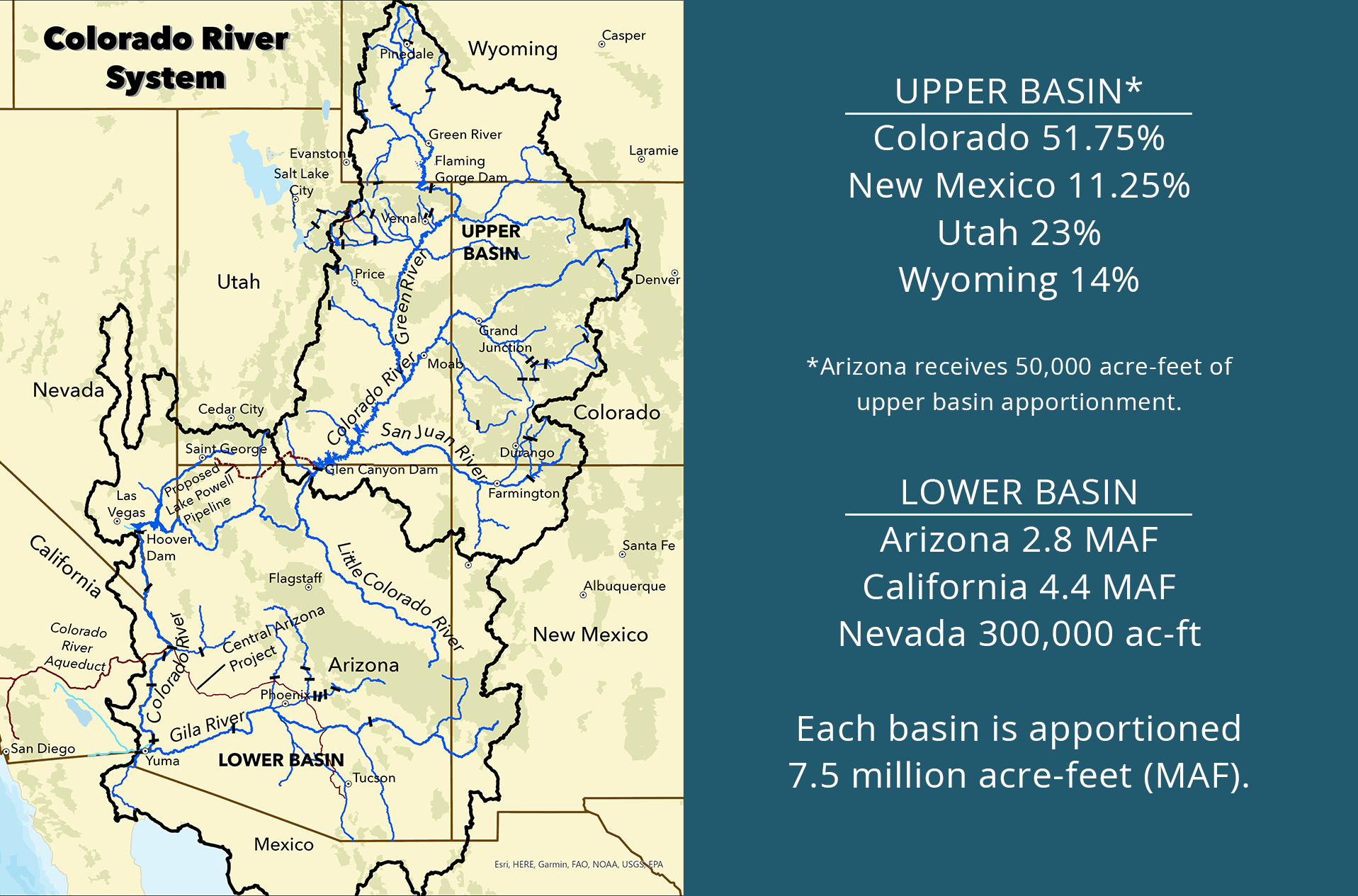
The river’s water is divided amongst 7 basin states through the 1922 Colorado River Compact. The compact, made when the southwest was not as populated and snowpack ran considerably higher, divided the basin in two; the upper basin (Colorado, Wyoming, Utah, and New Mexico) and the lower basin (Nevada, Arizona, and California). The agreement divides 15 million acre feet (MAF) in half, giving 7.5 MAF to each basin. Later agreements carved out 3.4 MAF for tribal nations – drawn from the allocations of the states where their reservations sit – and guaranteed Mexico 1.5 MAF per year.
Nevada’s Small Share, Big Conservation Record
Within the lower Basin, California has the largest and most senior share at 4.4 MAF, followed by Arizona with 2.8 MAF, and Nevada at just 300,000-acre feet, the smallest allocation of any compact state. Nevada also uses the least of what is allotted; Las Vegas used only 198,000 acre feet last year, a record of conservation unmatched among the seven states.
However, Nevada’s conservation has not been rewarded. In fact, the state was not spared from federal cuts. Between 2000 and 2024, the river’s average annual flow fell to just 12.4 MAF, well below the 16.4 MAF the drafters assumed. Amid persistent drought and the states’ failure to reach a voluntary agreement, the U.S. Bureau of Reclamation released its final Environmental Impact Statement on July 31, laying out mandatory reductions. The upper basin faces no required cuts, only an encouragement to conserve 200,000 acre-feet. The lower basin fares worse: under a ten-year framework, it must cut annual use by up to 3 million acre-feet – roughly the entire allocation of Nevada and Arizona combined – with the specific reduction revisited every two years based on drought conditions in the basin.
What the New Federal Cuts Mean for Nevada
Nevada’s share of that burden, under the current framework, is a mandatory cut of 50,000 acre-feet annually, rising to as much as 210,000 acre-feet in dry years. Final operating guidelines have not yet been published, so these figures could still change.
Governor Joe Lombardo has criticized the plan saying that it, “seeks to impose unrealistic reductions on Nevada and our water users” and warning it “could have devastating economic and environmental impacts on Nevada.” He called on “shared sacrifice from all water users across the Colorado River Basin.”
Why the Colorado River Matters to the Regional Economy
The stakes extend well beyond urban water use. The Colorado River supports 16 million jobs across the Southwest and contributes an estimated $1.4 trillion to the regional economy each year. Cuts of this magnitude carry consequences that reach far beyond the water sector itself.
Agriculture, Alfalfa, and the Cost of Cheap Water
Agriculture accounts for 74% of the river’s use, and roughly a third of that goes to alfalfa and grass hay – the most water-intensive crop grown in the United States. About 20% of the alfalfa grown in the region is shipped overseas. That practice drew scrutiny in 2023, when Arizona allowed a Saudi-owned company to grow alfalfa on state land; the state’s then-attorney general called it “outrageous” that foreign-owned firms could effectively “stick a straw in [American] ground” to grow crops destined for export rather than domestic use.
Yet agriculture tied to the Colorado River also generates roughly $60 billion annually in gross revenue, and 90% of the leafy greens Americans eat in winter are grown in the Southwest – a reminder that food security and water policy are tightly linked. Indiscriminate cuts to farming would carry real economic costs or would divert production to other regions. A more targeted approach would be to end the federal subsidies that encourage farming at a scale the desert cannot naturally support, letting market forces rather than blunt mandates determine which crops are worth the water they require.
Why Water Markets Are a Better Fix Than Pipelines and Mandates
Policymakers have floated a range of fixes: desalination plants, pipelines to import water from the East, and other large infrastructure projects. Each would cost billions of dollars, and taxpayers would bear the bill.
The real solution does not originate in Washington’s allocation formulas. It lies in water markets: allowing water rights to be bought and sold freely, so that water moves from lower-value to higher-value uses. Under a market system, conservation would emerge naturally in response to price signals rather than from expensive infrastructure or arbitrary mandates.
Water is currently priced far below its scarcity value, particularly in a desert region where supply is unpredictable. A 2025 analysis by UCLA found that water on the Colorado River is delivered to many districts at a weighted average of roughly $0.12 per acre-foot, compared with an average of $853 per acre-foot when water is acquired from non-federal sources. Even a modest charge of $50 to $100 per acre-foot, the report estimated, could raise up to $750 million a year.
When water is underpriced, demand becomes insensitive to scarcity, and there is little incentive to use it responsibly. California is the prime example: consumption keeps rising because underpriced water gives users no reason to conserve the way Nevada has been forced to. A market price that rises when water is scarce changes that – it rewards conservation and lets individuals and businesses adjust their own use rather than wait for government mandates to do it for them.
Western water law compounds the problem. “Use it or lose it” statutes and heavy restrictions on trading actively discourage conservation, since water users that cut back risk forfeiting their rights. A genuine market would instead let farmers and businesses sell unused water for a profit, turning conservation into a direct financial reward rather than a liability.
Nevada Has Earned the Right to Lead on Water Policy
This is not an argument for Nevada to claim a larger share of the river – it is an argument for a system that finally recognizes the share the state has already earned through decades of discipline. Nevada has grown from 81,000 to 3.2 million residents since 1922 and yet has the same allocation. In fact, the Silver State experienced the largest proportional population growth than any other compact state, leaving it with the lowest water allocation per resident – 0.09 acre-feet per resident.
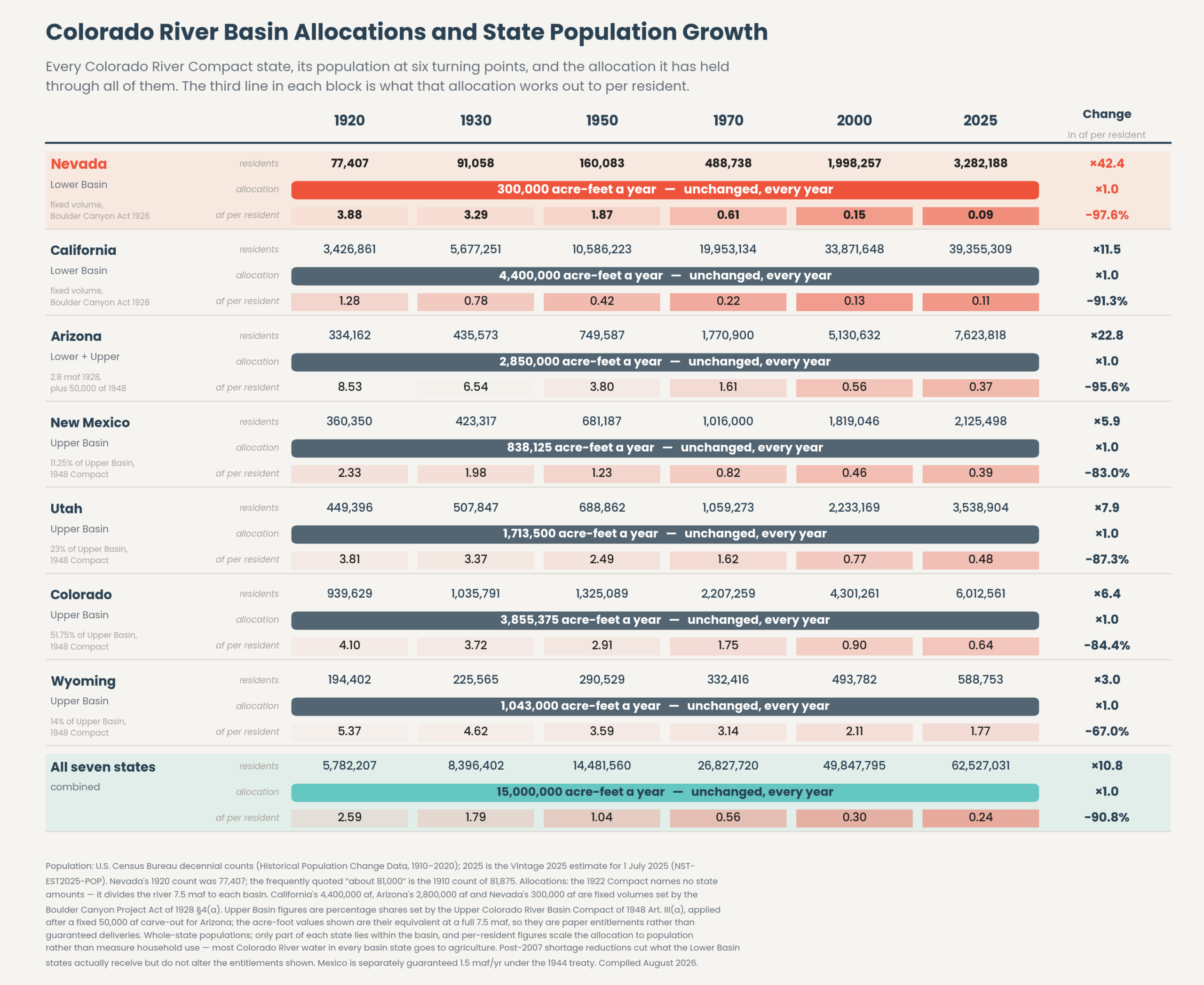
Nevada was forced to become a leader in conservation long before it became a federal priority. Under the compact, none of that innovation is rewarded: cuts are distributed largely by formula, regardless of which states have stopped wasting water and which have not. Free markets would fix that imbalance. It would let water follow demonstrated demand and reward the hard work of conserving, instead of absorbing the same proportional cuts as states that never had to try.
Water markets are not a foolproof fix; they require transparency and trust to function well. But if the West is serious about conserving the Colorado River to sustain many of the fastest growing metropolitan areas in the U.S., water needs to compete for its highest use through voluntary exchange rather than political decree. Nevada, already the regional leader in conservation, is well positioned to lead its six compact partners in building that market.
Protect Nevada’s Land and Water Before Washington Decides For You
Federal agencies and out of state interests are shaping the rules for Nevada’s water, public lands, and natural resources right now. Sign up for free market policy updates on the issues affecting Nevada’s land and water, delivered straight to your inbox so you can stay ahead of the decisions that affect your community.