
For years, Nevada’s housing market was heavily shaped not only by supply and demand but also by lawsuits.
Since the early 19th century housing purchases in the United States have been governed by the caveat emptor principle – meaning that it is incumbent upon the purchaser to research and inspect any defects within the property for sale and to make his offer commensurate with his knowledge of defects. This principle, consequently, assumes that the seller has no responsibility for any defects following the purchase unless they have deliberately misrepresented the property.
In the 1960s, this approach quickly shifted in Western states following a series of court rulings. The emerging body of “construction defect laws” was swiftly amplified into statute in California, opening up a potentially lucrative avenue for trial lawyers through construction litigation.
The Origins of Construction Defect Laws in Nevada
In 1995, largely because of the powerful lobby of the Nevada Trial Lawyer Association, Nevada codified a similar statute in NRS Chapter 40. Chapter 40 created contingent liabilities for builders and developers because they could be held liable for renovations or repairs years after having sold a property. This liability was especially concentrated into multi-family housing projects where litigants could claim that an alleged defect was replicated across all units.
Homeowners associations (HOAs) were empowered to initiate these lawsuits, and trial lawyers had a clear profit motive to enlist these HOAs as clients to seek massive settlements from property developers. Lawyers could also seek unlimited “prelitigation” fees regardless of whether a case was even filed.
Insurers for builders quickly fled the market. By 2003, almost no insurers remained in Nevada. Not surprisingly, this climate led to a dearth of condominium and townhome construction, which are often the first step to homeownership.
FBI Investigation Reveals Fraud in Nevada Construction Defect Cases
The statutory language itself was not the most problematic aspect, but the degree to which it was abused. Nevada became the epicenter of a massive fraudulent construction defect law litigation scheme, which prompted FBI’s Operation Grandmaster. Operation Grandmaster was the single largest federal public corruption investigation in Nevada’s history. It spanned from 2007-2017, investigated more than 100 people and dozens of companies, and resulted in the federal indictment and conviction of 44 subjects.
The scheme was rather complex. First, many HOAs in the state controlled multi-million-dollar budgets with little to no oversight and the legal right to initiate lawsuits. Seeing this as a window of opportunity, conspirators sought to join HOA boards for the express purpose of initiating construction defect lawsuits. Conspirators sometimes gained eligibility to run for HOA boards through fraudulent purchases of condominiums, and then engaged in bribery and election rigging to control board seats.
They then collaborated with various contractors and law firms to initiate lawsuits that would result in large settlements. Once the multi-million-dollar settlements were reached, settlement dollars could be awarded to both participating attorneys and the conspirators who initiated the suits on behalf of HOAs.
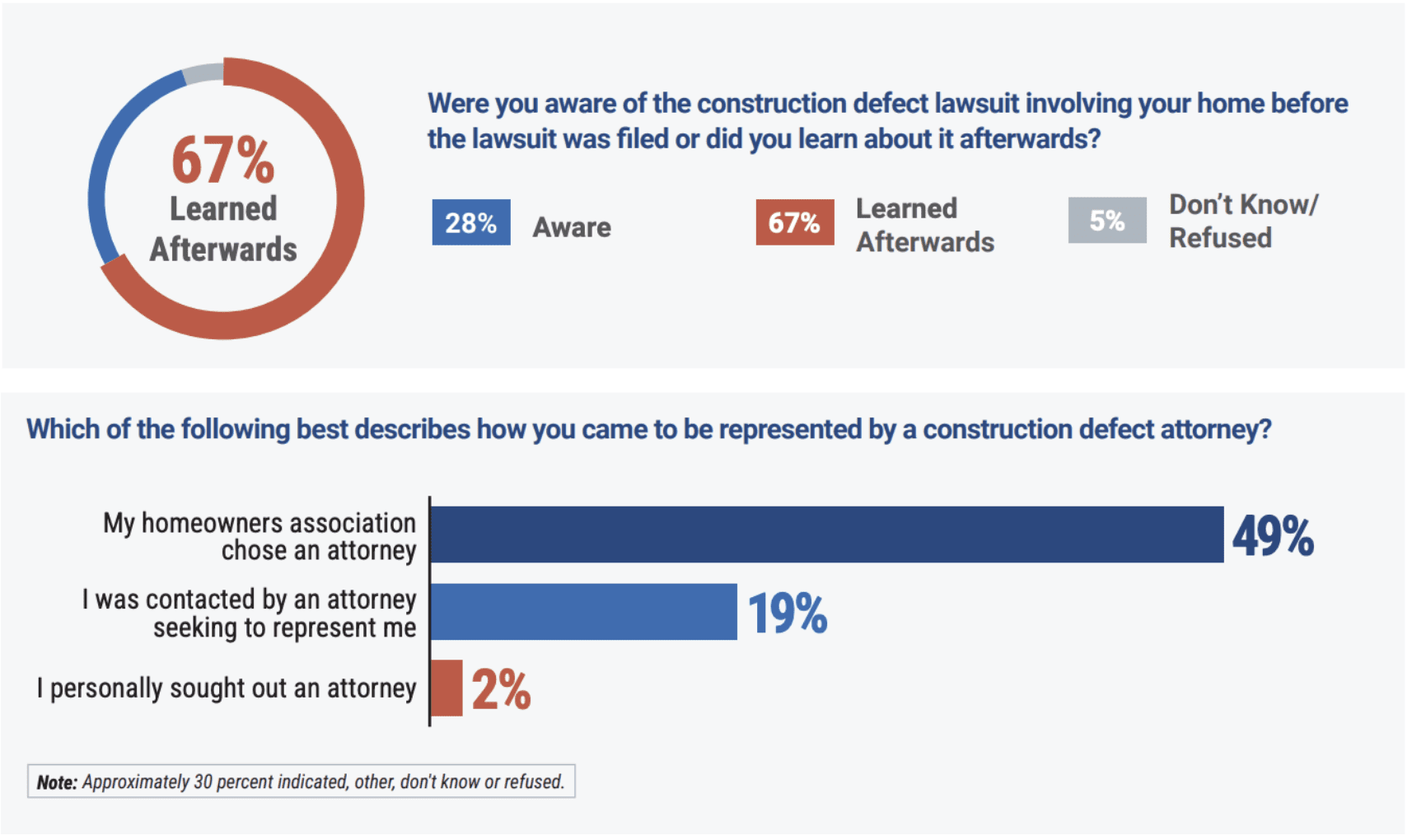
The scheme involved attorneys, construction professionals, Las Vegas Metropolitan Police Department officials, and more. In many instances, these suits were filed on behalf of entire neighborhoods, even though many residents reported being unaware of the litigation. In 2015, 67% of surveyed residents reported learning about their construction defect lawsuit after it was filed—they had never complained of any defect with their home. In fact, many homeowners saw their property values decline when the property became subject to a construction-defect lawsuit without their knowledge.
How AB 125 Reformed Nevada Construction Defect Laws
In 2015, the state legislature finally got involved and enacted reforms through Assembly Bill 125. AB 125 narrowed the definition of a construction defect to items that present “an unreasonable risk of injury to a person or property” or that are “not completed in a good or workmanlike manner and proximately causes physical damage to the residence.”
The bill further removed the guarantee of legal fees for attorneys. Importantly, it also barred homeowners’ associations from initiating construction-defect lawsuits unless the defects were in the common space areas of the living complexes and lowered the time the statute of limitations for filing claims from 10 years to 6 years after construction.
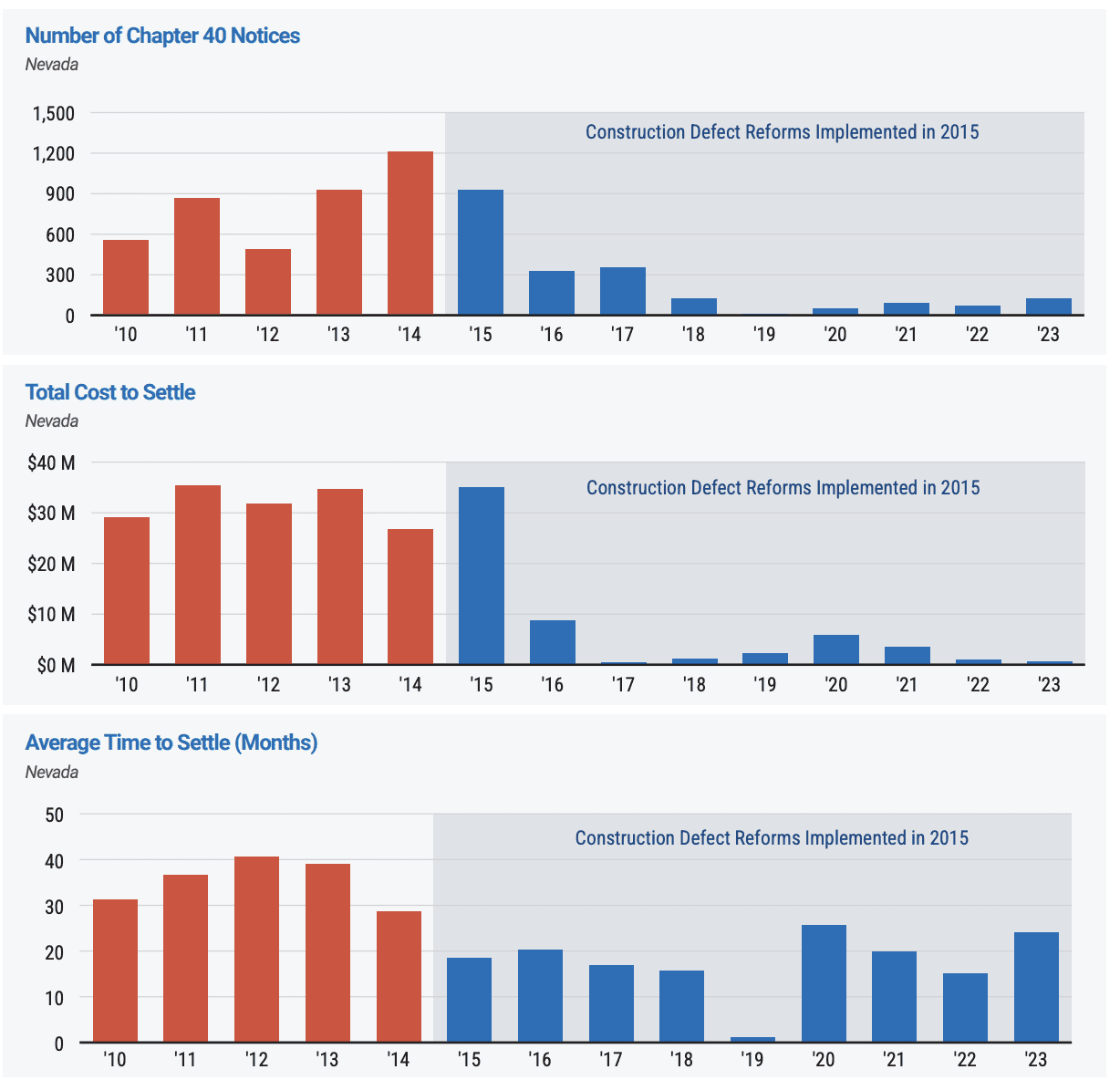
Following these reforms, the number of Chapter 40 lawsuits, the average costs and times to settle all decreased.
Did AB 421 Reverse Progress on Housing Affordability in Nevada?
However, four years after AB 125 was enacted, policymakers revisited the statute in 2019, reversing many of the reforms by passing Assembly Bill 421. AB 421 partially restored the HOAs’ ability to initiate lawsuits and returned the statute of limitations for filing claims back to 10 years. Additional changes in 2019 weakened the notice requirements to contractors and relieved plaintiffs from first exhausting claims under a homeowner warranty.
Notably, the bill drew heavy opposition from the Nevada Homebuilders Association, various Chambers of Commerce, and even included a testimony from Michael Elliot – a Special Agent of the FBI Public Corruption Unit, who was the case agent on Operation Grandmaster. The opposition warned that the passage of AB 421 would risk losing all the progress that previous reforms had made and would open the floor for million-dollar fraudulent lawsuits, again. Nevertheless, the bill passed through the legislature and was signed by Governor Sisolak.
Such political turbulence signals to the market that Nevada is vulnerable to sophisticated schemes and could again discourage construction for sale of multi-family homes. Effectively, this eliminates a whole tier of housing – attached housing options such as townhomes and condominiums – from the market. These types of housing often draw first-time homebuyers due to their affordability, but extremely high insurance rates make it an ineffective investment for developers and once built, an expensive purchase for buyers.
Why Construction Defect Policy Still Threatens Nevada Housing Supply
Despite the common-sense economics that point out the flaws of overreaching construction defect laws, Carson City had yet another measure, Assembly Bill 505, introduced in 2025. Although the bill did not receive a hearing, it was another signal to the business community that policymakers are considering burdensome insurance requirements and paving the way for the same old mistakes.
As future reforms are being considered to make housing attainable for Nevadans, this issue should not be an afterthought. Because in housing policy, as in construction itself, a weak foundation does not hold, and Nevada cannot afford to rebuild the same mistakes twice.
Stay Informed on Nevada Housing Policy and Reform
Nevada’s housing challenges didn’t happen by accident—and the solutions won’t either. If you want clear, data-driven insights on the policies shaping housing, affordability, and opportunity across the state, stay informed. Sign up for our newsletter to get research, analysis, and updates delivered straight to your inbox—so you can better understand what’s happening and what comes next.