
Nevada is unlike any other state in the union when it comes to land ownership.
47 percent of all the land in the United States is controlled by the federal government, but that number rises dramatically in Nevada, where approximately 85 percent is managed by federal agencies such as the Bureau of Land Management (BLM) and the U.S. Forrest Service. In some rural counties, federal ownership exceeds 90 percent.
With the majority of land in federal control and only a fraction of private ownership of Silver’ State’s 70 million acres, every aspect of Nevada’s development and economy is limited.
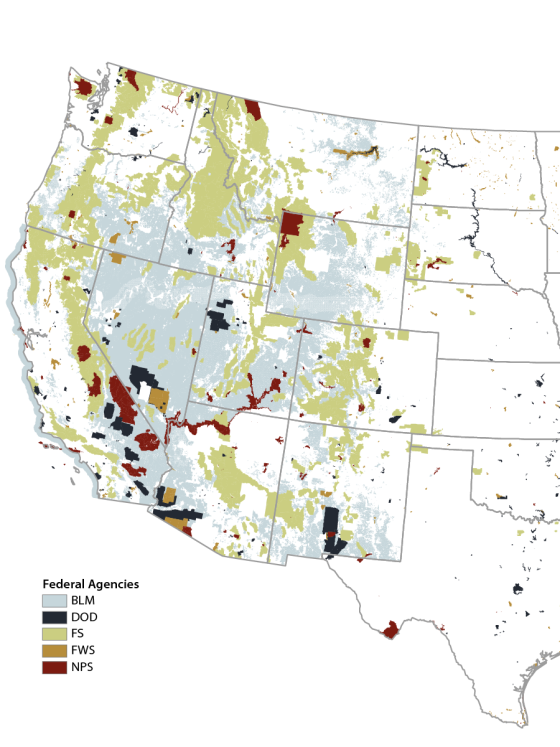
Source: Hanson, Laura A., Vincent, Carol Hardy, “Federal Land Ownership: Overview and Data,” Congressional Research Service, https://www.congress.gov/crs-product/R42346
Housing costs, mining operations, grazing rights, water access, and energy development are all influenced by decisions made in Washington, D.C., by faraway agencies that do not live in the communities directly affected.
How Federal Land Ownership Began in Nevada
Federal land ownership in Nevada dates back to before its statehood. After the Mexican- American War, Mexico ceded about half of its territory to the United States. Through the Treaty of Guadalupe, areas like modern-day California, Utah, Arizona, and Nevada were acquired. Nevada then became a territory of the United States in 1848.
At the time, federal ownership of land was not meant to be permanent. In the 1800s, the territories that the government owned were viewed as assets to be sold off to reduce national debt, fund public institutions, and to be used for agriculture.
American policy favored the disposal of public lands, with Congress passing laws to enable the transfer of federal ownership to private entities or state governments. The Homestead Act of 1862, awarded 160 acres of public property to people who would agree to manage and homestead the land.
After 5 years of making improvements to the land and farming the property, the person received the title to the land. Millions of acres were transferred to private individuals through this act. Similarly, Congress transferred large amounts of land to states or railroad companies. States used those land grants to fund universities through the Morrill Land-Grant Act of 1862.
Federal land ownership was understood to be temporary. Public lands were acquired with the expectation of being handed over to the states who, in turn, could grant or auction these lands for other purposes.
Nevada Statehood and the Promise of Land Disposal
When Nevada entered the union in 1864, like many western states, it was granted statehood under an enabling act – a law passed by Congress that allows a federal territory to draft a constitution and apply for statehood. Each state’s enabling act outlines specific conditions that a state must meet to qualify for statehood.
Nevada’s enabling act required the territory to disclaim rights and title to unappropriated lands. However, at the time, the ultimate disposal of federal land remained the zeitgeist, and the disclaimer of interest was intended to clear title so that deeds could later be transferred without dispute.
The Silver State’s geography complicated that process.
Much of Nevada is mountainous, arid, and difficult to farm. Unlike other parts of the west and mid-west, large-scale agriculture was not feasible, so there was never much demand for transfer of these lands in the early decades of statehood. By the end of the century, however, federal intent regarding land ownership began to shift as the Progressive Era conservationist movement lobbied for indefinite government ownership of large swaths of the United States.
The Rise of the Conservation Movement and Permanent Federal Control
Amid concerns about deforestation, overgrazing, and soil erosion, conservationists argued that forests, grazing land, watersheds, and mineral resources were too valuable to be transferred into private ownership. Instead, they believed that natural resources were better off being managed by government experts to ensure their long-term productivity. This movement resulted in policies that withdrew millions of acres away from settlement and into the control of the government.
In 1891, the Forest Act was passed, which allowed the President to set aside land for public forest reservations. This marked the beginning of an era when the government started reserving vast tracts of land for environmental purposes. Additional laws and regulations were put into place over the next several decades, with a landmark decision in 1934 known as the Taylor Grazing Act. This act removed much of the remaining open rangeland that ranchers used to graze cattle and placed it under federal control.
Starting then, ranchers had to use grazing districts and buy permits to use the land. The byproduct of Taylor’s Grazing Act was the establishment of the grazing division, which eventually became the Bureau of Land Management. Today, the BLM manages more land than any other government agency in the United States.
The Federal Land Policy and Management Act Changed Everything
The shift from disposal to management became official in 1976, with the passage of the Federal Land Policy Management Act (FLPMA). FLPMA marked a major turning point: it reversed the practice of transfer by declaring that the remaining public lands would be managed by the government indefinitely.
Even as Nevada’s population and industry has grown throughout the 20th and 21st centuries, federal agencies have retained an iron grip on control of the state’s lands. In 1990, Nevada was home to roughly 1.2 million residents, and the federal government controlled approximately the same share of land that it does today.
More than three decades later, Nevada’s population has grown to over 3.2 million people, yet federal agencies still control about 85 percent of the state’s acreage. Evidently, the disposal of public lands has not kept up with the rapid growth of the state.
Is Nevada’s Land Ownership Model Still Serving the State?
Whatever the original intent of a disclaimer of interest in public lands may have been, it is clear that federal land dominion today massively constrains the growth of Nevada’s largest communities, leads to higher housing prices, and limits the growth of rural industries like mining and ranching. In Southern Nevada, estimates published in the Washington Post suggest that housing for 3.5 million people could be built on developable BLM land within two miles of Las Vegas city limits.
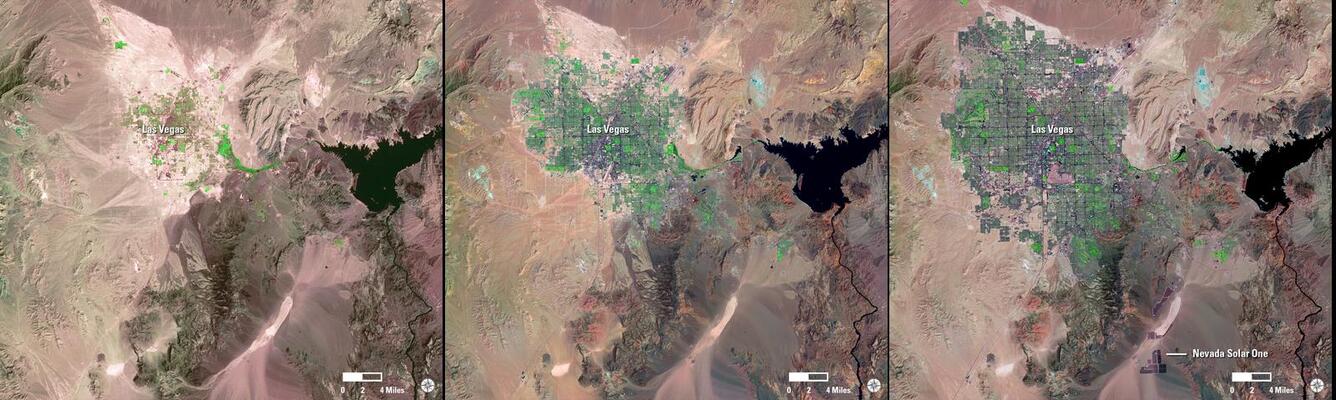
Source: United States Geological Survey, “Urban Growth in Las Vegas, Nevada, USA,” https://www.usgs.gov/media/images/urban-growth-las-vegas-nevada-usa
Nevada is trapped by a land ownership pattern that was never designed for a growing state. Decisions about where businesses can invest, where homes can be built, and how natural resources can be developed are controlled by federal agencies rather than people who work and live in the state.
As housing costs rise and economy remains constrained to small islands of private properties across an ocean of BLM land, the question Nevada should ask is whether federal land ownership, regardless of its outdated intent, still serves the needs and interest of the state today.
Stay Informed on Nevada Land and Water Policy
Nevada’s future depends on how the state manages its most valuable natural resources. From federal land ownership and water rights to housing, energy, and economic development, these issues affect every Nevadan.
Sign up for our email newsletter to receive timely analysis, research, and updates on the policies shaping Nevada’s land, water, and economic future.