
When headlines statewide warn about the looming budget cuts to Clark County School District schools, the immediate public assumption can be that the district is starved of resources. But the numbers, as reported by the Review Journal earlier, tell a different story. Although the budget crunch has been attributed to reasons such as enrollment decline or insufficient financial resources, the true essence of the failure lies in the district putting money in places that prioritize the wrong things.
Why CCSD Kept Spending More as Students Kept Leaving
In a per-pupil funding system, dollars follow the child. Official enrollment data has demonstrated a steady decline in district enrollment since 2008. Although Clark County continues to be a preferred destination for inward migration, more and more parents are choosing alternative options for their child’s education. These include charter schools, magnet schools, private schools, or homeschooling.
This is not a temporary fluctuation, but a consistent trend formed both in the Silver State and nationwide. In fact, most recent enrollment trends suggest that charter schools are at maximum capacity (explaining the relatively flat curve since 2022), so parents increasingly resort to homeschooling.
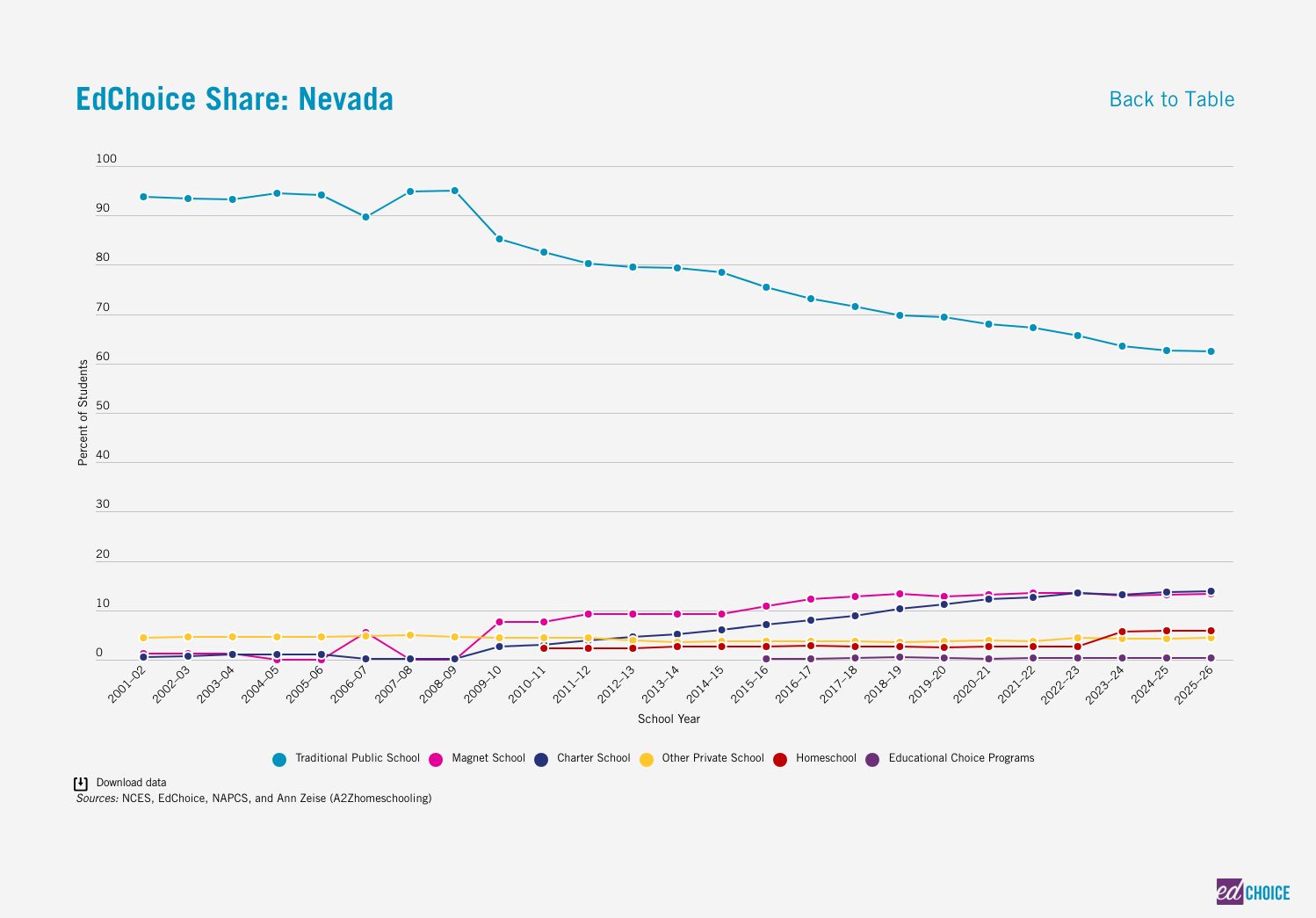
In any other market, the steady flock of consumers to other competitors would have prompted rapid and radical reform, but CCSD failed to catch up with their customers—families with children. Instead of investing in policies that would adjust spending to the declining enrollment of students, the district seems to have operated under the assumption that students will return even without a change in approach. And that is, to a degree, unsurprising.
For decades, district-run schools have held a monopoly in available educational options, leaving parents with little choice over their children’s education. So, despite the evident warning patterns, school districts kept building and increasing staff and compensation levels, especially for administrative positions. This approach literally amounts to doing more of the same, when families demand innovation and performance.
Competitors to public schools have developed innovative approaches – they create hands-on learning environments, offer a variety of elective courses, and hire experienced professionals to teach specialized courses regardless of whether they hold a state-issued teaching license. The result is education that is geared toward inspiring students and driving them to achieve.
The Union Factor: How CCEA’s Political Power Shapes CCSD’s Budget
Institutional inertia isn’t the only problem plaguing CCSD. Legislative intervention has hampered the district’s flexibility by kowtowing to the politically influential Clark County Educator’s Association (CCEA). Most recently, the legislature granted CCEA the protected right to strike and it has consistently empowered the union against the district.
For decades, administrators have been required by law to negotiate toward a union contract, and a mandatory arbitration procedure already guaranteed a union contract would be reached—even without a strike. In 17 states, school districts aren’t even required to negotiate with unions and nearly all these states boast greater educational outcomes than Nevada.
The 20% Teacher Raise That’s Now Costing Over 1,000 Jobs
The legislature’s meddling on behalf of unions has introduced some short-term benefits to union members, but, in the long run these interventions have prioritized adults over children and chased customers—families—away. Just three years ago, the legislature appropriated money to grant across-the-board raises of 20% for teachers; a reform that, in retrospect, is one of the reasons why the district will be unable to afford over 1,000 employees in 2026-27 academic year.
When payroll constitutes the vast majority of a district’s operating budget, unsustainable labor agreements become budget crises very quickly. These measures are often reactions to the seemingly never-ending ballot initiative threats or intense lobbying by CCEA. As a result, the teacher union has undeniably become a powerful political player, bringing education to Carson City chambers instead of Clark County classrooms.
What CCSD Must Do to Become a School District Worth Choosing
Nevada taxpayers have invested record high amounts in public schools in recent years. The policy challenge lies in aligning that spending with performance, recognizing the district exists in an increasingly competitive environment. If spending alone translated into better quality education, we would already see parents returning to public schools. That’s not happening.
The main task of CCSD and CCEA should be not protecting the system but making it worth choosing.
Stay Ahead of Education Changes in Nevada
Education policy in Nevada is changing fast—and those changes directly impact your child’s opportunities. Get clear, timely updates on school choice, new programs, and policy decisions that matter for your family. Sign up for our newsletter to stay informed, prepared, and confident in every education decision you make.