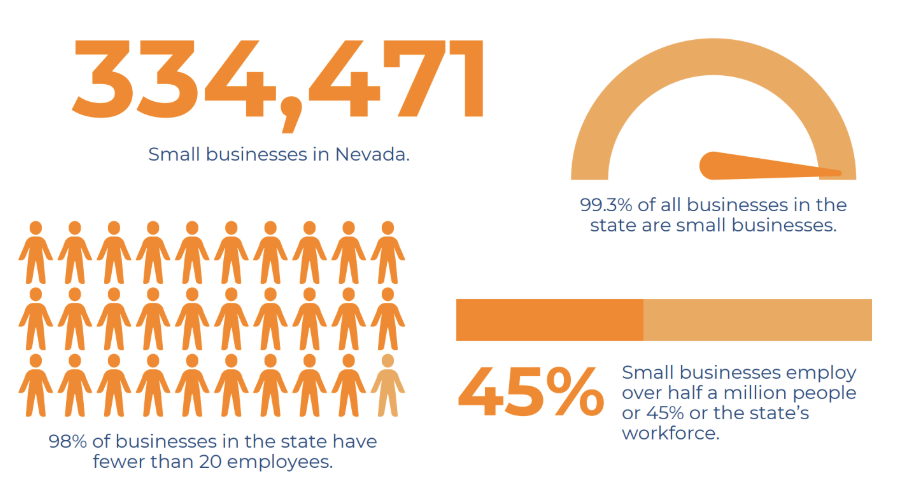
Small businesses serve as the backbone of Nevada’s economy. Across the state, 99.3% of businesses are classified as small businesses, and they employ 45% of the workforce. During the National Small Business Week, state policies affecting small enterprises call for thorough examination, as more than half a million Nevadans depend on the success of small businesses of the state.
A great way of measuring the economic growth and health of the state is the number of new businesses per thousand residents. Domiciling new and existing enterprises is a competition among the states, and more businesses generally bring more economic activity into the state. Nevada ranks 9th in the nation for new business applicants per thousand residents, signaling competitiveness and favorability for business formation. However, it is vital for the state to design and maintain a policy climate that allows small businesses not just to register but also to grow and succeed with no hurdles.
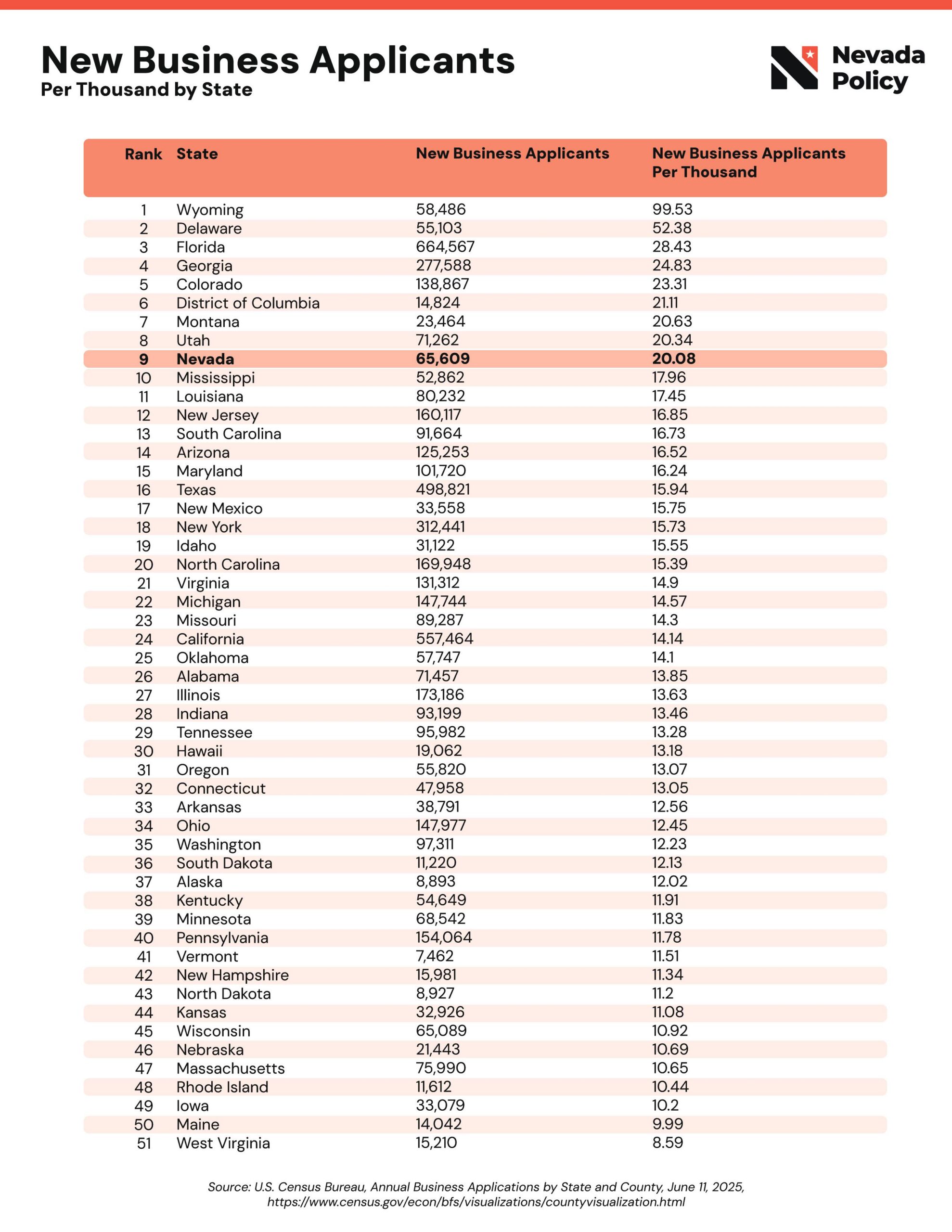
Nevada’s economic climate has long benefited from advantages such as lack of income tax and a growing population. Yet, states like Florida, Montana, and Wyoming, that are ahead of Nevada in the rankings offer a more valuable benefit – they impose fewer regulatory barriers on entrepreneurs. If the Silver State wants to remain in the competitive race of attracting new businesses, state policymakers need to address the policies that slow small business growth.
Fees, Fees, and More Fees
One of the first costs associated with starting a business are registration and licensure fees. Entrepreneurs in Nevada face an annually renewable license fee of $500 for corporations and $200 for other entities, often layered on top of additional local fees. For already successful companies these might be manageable costs, but for newer ventures high registration fees are often deterrents to entry. By contrast, states like Wyoming, Florida, and Montana (all ahead of Nevada by the number of new business applicants per capita) impose significantly lower fees ranging from $50-$125. Lowering the initial fees would encourage more entrepreneurs to enter the market and increase competition across industries.
Occupational Licensures in Nevada
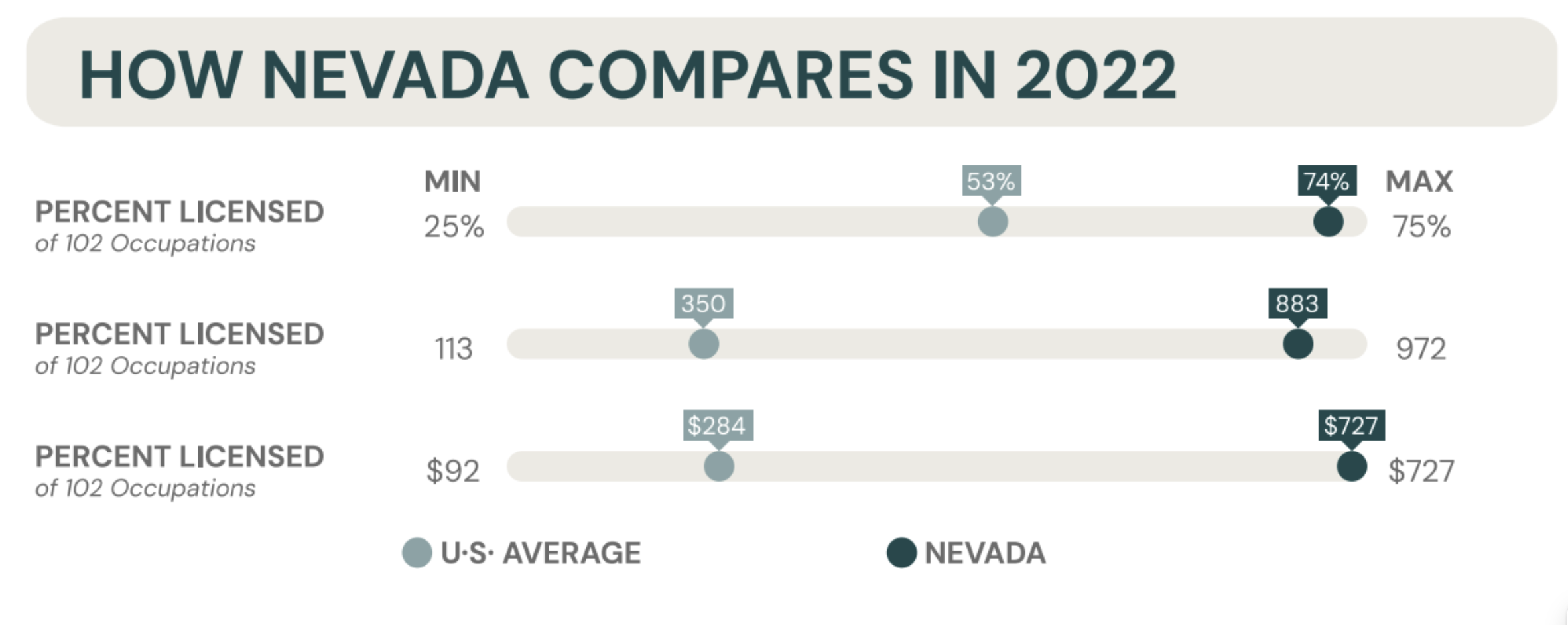
While registering a business might be a relatively straightforward process, operating one with skilled employees may be a challenge in Nevada. The Silver State is among the most onerously licensed states for occupations both in money and time. Professionals here on average spend more days and more money to obtain occupational licenses compared to their counterparts from other states.
For example, to obtain a license in Nevada, interior designers need to complete four years of education, two years of practice, pass examinations, and spend nearly $1,600 in fees. By contrast, 48 other states do not even require interior designers to hold occupational licenses. The same approach exists for occupations in cosmetology, construction, etc.
While licensing is often promoted as a consumer protection measure, in Nevada it has become an income stream for the state’s growing number of boards and commissions, discouraging entry into occupations and complicating hiring practices for many. Shrinking the labor pool increases costs for small businesses, passes them down to consumers, and complicates growth.
Unexpected Taxes for Businesses
While the state does not impose income taxes, Nevada is famous for its gross receipts tax. In 2015, lawmakers enacted the Commerce Tax, which applies to businesses generating more than $4 million in gross receipts. Unlike traditional taxes, it is levied on revenue rather than profit, meaning businesses can owe taxes even if they are not profitable.
This structure can also create a pyramid tax effect, where the same product is taxed multiple times as it moves through the supply chain. Additionally, the tax rate varies across 26 different industries, allowing governing bodies to demonstrate preferential treatment.
Not surprisingly, major industries of the state like gaming and real estate investment trusts are exempt from the provision, making it more likely for the burden to be carried by small businesses. Eliminating the Commerce Tax would remove a significant tax burden from small and expanding businesses.
Hidden Complex Regulations
Incremental regulations continue shaping the daily realities of small businesses in the state. For example, in the 2025 legislative session lawmakers approved a series of regulations and across-the-board mandates such as: mandatory monitoring of air quality, a ban on usage of polystyrene containers, and additional licensure requirements for ghost kitchens.
Individually, each requirement may seem small, yet when taken together they can increase costs and complicate daily operations for many small business owners, especially when they don’t have dedicated legal and advisory teams to keep track of the state’s ever-growing regulatory handbook.
Nevada’s Labor Policies
Labor policy is another balancing act that policymakers attempt to master every session. There is an understandable desire to increase worker protections, yet if done incorrectly, the cost of these policies can be burdensome for business growth and the very emergence of the jobs these workers occupy.
Proposals like AB 388 of the 2025 legislative session mandating a 12-week paid leave for new employees, signal that the state is open to imposing significant financial strain on entrepreneurs. Although the bill was not enacted, some enacted policies, such as a prevailing wage mandate for natural gas infrastructure projects, still send the same message to small businesses. These increased costs don’t just disappear in a vacuum; instead, they are passed down to consumers, employees, or absorbed by businesses operating on thin margins.
Business Policy Matters
To keep or improve its rank for new business applicants, Nevada needs to maintain a policy environment that empowers entrepreneurs and fuels growth. The states that are ahead in the race offer a non-interventionist environment in which individual producers and consumers are able to freely interact with each other.
State interventions like fees, licensure, taxes, and mandates add up, and can often cost otherwise successful businesses their entire operation. The Silver State already has a clear advantage in attracting small businesses, and the path forward is clear – reduced barriers, reduced costs, and reduced regulation.
Small businesses are clearly the backbone of Nevada’s economy, and public policy should empower their growth rather than imposing new barriers.
Stay Ahead of Nevada Policy Changes
Nevada’s business climate can change quickly, and the policy decisions made today shape the opportunities available tomorrow. Sign up for the Nevada Policy newsletter to get timely analysis on state legislation, economic trends, and reforms that affect small businesses, workers, and families across Nevada.