
If you have ever scrolled through Instagram, sent a text, used Google’s search engine, or streamed a movie on Netflix, then you have utilized a data center.
In recent months, data centers have been the center of public debate. Critics portray them as giant resource-hungry facilities that will drain our water supplies, consume every available watt of electricity, and cover the landscape with massive industrial buildings. But the truth is far more nuanced.
What Is a Data Center?
A data center is a physical facility housing servers, routers, and hard drives that store, process, and distribute digital information. Every text message, Google search, banking transaction, and digital hospital record depends on one. Institutions and tools that power our daily lives and the global economy – governments, hospitals, banks, apps and artificial intelligence – all rely on data centers.
A Brief History of Data Centers
While the recent heavy media coverage may make data centers seem like a new development, they have quietly powered the world since the 1940s. The large computing facilities first appeared in the 1970s, serving governments and universities.
In the early 2000s, companies like Amazon, Google, and Microsoft transformed the industry by introducing cloud computing which allowed businesses to rent computing power rather than own hardware. Think of it like the shift from private generators to a shared power grid. The efficiency gains were enormous, but they required massive, centralized facilities to deliver them.
To reduce lag time for users, companies later built smaller “edge” data centers distributed closer to population centers. Today, the next wave of demand and innovation for more data centers is being driven by artificial intelligence, which requires faster networks and more sophisticated cooling.
How Much Water Do Nevada Data Centers Actually Use?
Nevada is the driest state in the nation, so conversations surrounding data centers always raise alarms about water usage. But are data centers simply too thirsty to live in Nevada? Data centers primarily use water to prevent their servers from overheating.
According to a report from the Lawerence Berkley Laboratory Institute, data centers directly consumed 46 million gallons of water per day in 2023. The indirect number consumed from power plants totaled 576 million gallons per day. Combined for a daily total, data centers used 625 million gallons per day. That number seems astronomical until you compare it to the 322 billion gallons used per day in America.
This means that data centers nationwide were responsible for a mere 0.2% of the total water consumption. On the other hand, American golf courses use approximately 2.08 billion gallons of water per day. The almond industry in California uses a shocking 4.2 billion gallons of water daily.
Consequently, it is not surprising that Nevada currently has 70 data centers that are in use, under construction, or in the planning phase, providing the state with real-life data about their water usage.
Nevada Data Center Water Use by Facility
Google’s southern Nevada facility in Henderson leads the pack, using approximately 352 million gallons of water in 2024. Flexential’s North Las Vegas facility consumed around 20 million gallons that same year. Near Reno, the proposed Keystone and Webb data centers are each projected to need roughly 651,000 gallons annually, according to the Truckee Meadows Regional Planning Agency (TMRPA).
Google’s air-cooled facility in Storey County withdrew 1.9 million gallons in 2023 but consumed only about 200,000 gallons — returning the rest to the system. This center uses no water for server cooling, relying instead on air-cooling technology, demonstrating that with the right design, data centers can operate on surprisingly little water.
Putting Nevada’s Water Use Into Perspective
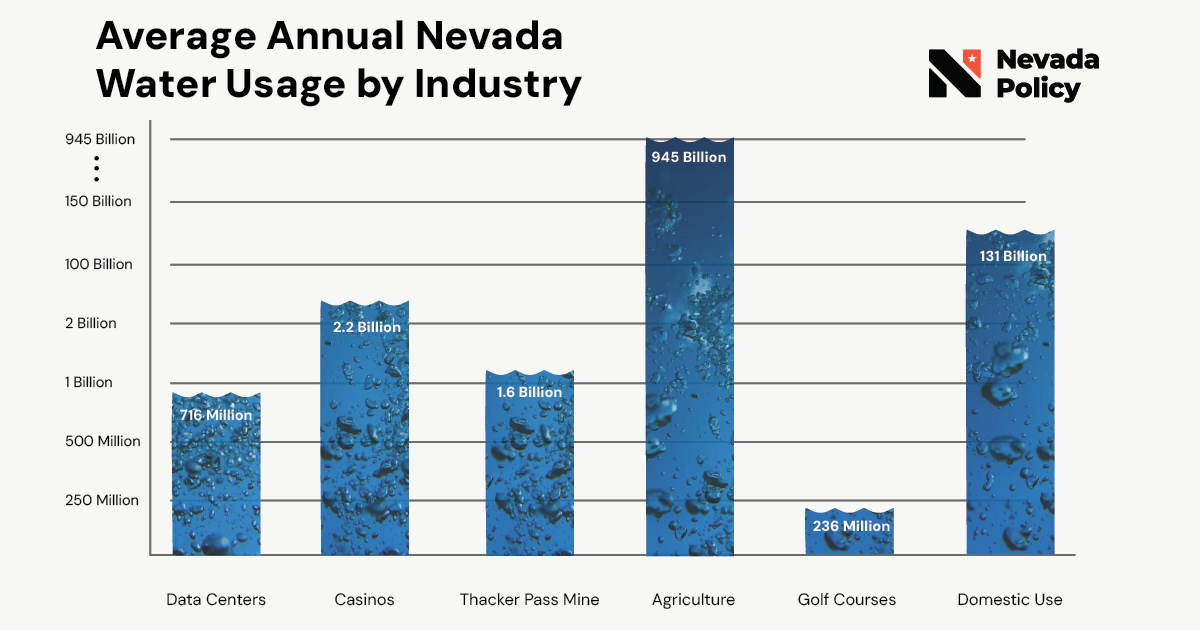
A bird’s eye view of annual water usage by the sector in Nevada paints a clearer picture. Every year agriculture is estimated to use 945 billion gallons of water in the state, the top five casinos on the Las Vegas Strip use 2.2 billion gallons, and the Thacker Pass mine uses 1.6 billion gallons, All considerably more than existing data centers.
How Nevada’s Tech Industry Is Cutting Water Use
Beyond the raw numbers, Nevada’s data center industry has increasingly invested in technologies that reduce water consumption through recycled-water systems, renewable energy generation, liquid cooling, and in some cases the elimination of cooling-water uses altogether.
Tahoe Reno Industrial Center (TRI Center), home to Google, Tesla, and Switch, use non-potable, recycled water. In 2021, state and local officials broke ground on the Regional Water Improvement Pipeline Project, a 16-mile pipeline that will transport up to 4,000 acre-feet of treated wastewater from the Truckee Meadows Water Reclamation Facility to the Tahoe Reno Industrial Center. The public-private partnership, led by the TRI Center and Switch, was developed so that purified, recycled water could be used as a solution to water needs in a state that is plagued with drought.
The Economic Case for Data Centers in Nevada
On top of the constant innovation to find the most efficient use of water, the economic benefits of data centers are substantial and often misconstrued.
Major hyperscale data-center projects can generate thousands of construction jobs during the buildout phase. A data-center campus currently being built in Wyoming, for example, is expected to employ more than 5,000 construction workers.
Permanent employment, after the construction phase, varies from dozens to a few hundred jobs depending on the size of the campus. Additionally, the average data center salary is $160,000, nearly double of the national median income in the U.S.
Industrial activity is never without costs, and data centers are no exception. What matters is not whether they leave a mark — it is whether that mark is proportionate to what they enable, and whether it is being actively minimized.
Nevada’s Path to Leading on Data Centers
Built in the middle of a scorching desert, Las Vegas has never been a city that was supposed to succeed. That same spirit of engineering solutions where none seem possible may be exactly what positions Nevada to lead the nation in sustainable data center development. The modern economy runs on data centers just as previous generations relied on railroads, highways, power plants, and telephone lines, so harboring their growth and innovation is an economic no-brainer. Nevada has something many states do not: vast amounts of land, room for growth, and a business climate that attracts investment.
The real policy question is not whether data centers belong in Nevada, it is whether Nevada will remain competitive enough to attract them on the merits, without special favors, and on terms that serve Nevada taxpayers and businesses alike.
Stay Informed on the Issues Shaping Nevada
Want more breakdowns like this one? Sign up for the Nevada Policy newsletter and get the facts on energy, water, government spending, and the policies shaping your state, delivered straight to your inbox.


